Sandor Fuss – A New Breed of Collector?

Jeff Wichmann, owner of American Bottle Auctions in Sacramento, California recently published (15 March 2011) a rather well done article on his website blog, www.american bottle.com called Collector Profiles: Sandor Fuss – A New Breed of Collector?

Jeff is one of the best writers out there in any hobby and Sandor certainly is worth writing about. Check it out!

Sandor Fuss Family Portrait

Fuss Family Portrait

Posted in Article Publications, Collectors & Collections, News | Tagged , , | Leave a comment

FOHBC Membership Booklet Ad – 2011

FOHBC Membership

FOHBC Membership Booklet Ad - 2011

Posted in Article Publications, Bitters, Figural Bottles, FOHBC News | Tagged , , | Leave a comment

FOHBC Memphis, Tennessee Show Program Ad – 2011

Memphis Program Ad

FOHBC Memphis National Show Program Ad - 2011

Posted in Article Publications, Bitters, Color Runs, FOHBC News | Tagged , , , , , , , , | Leave a comment

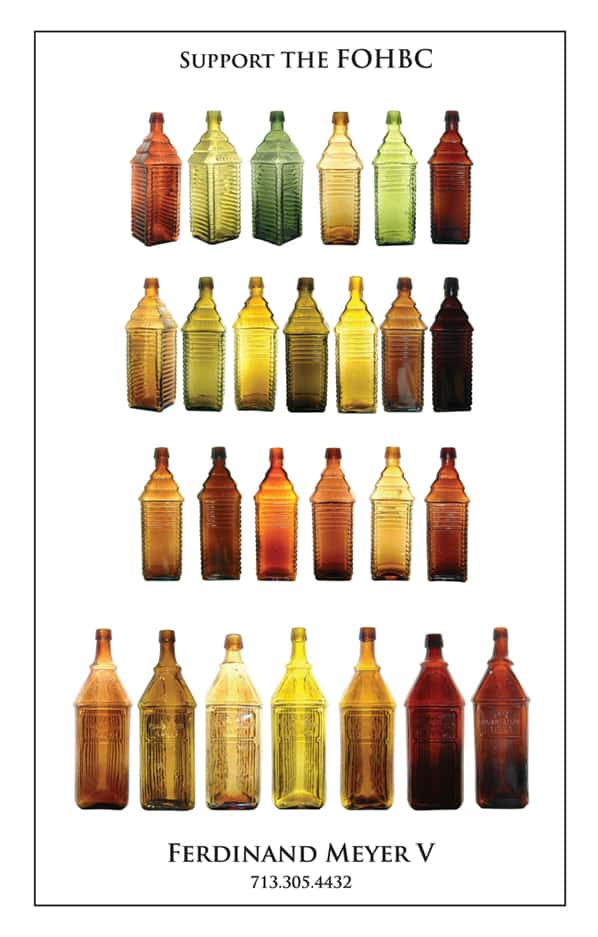
FOHBC Wilmington, Ohio Show Program Ad – 2010

FOHBC Wilmington Ad

FOHBC Wilmington, Ohio Program Ad - August 2010

Posted in Article Publications, Bitters, Bottle Shows, Collectors & Collections, Color Runs, FOHBC News | Tagged , , , , , , , | Leave a comment

The Perfect Name for a Barrel…Old Sachem Bitters and Wigwam Tonic

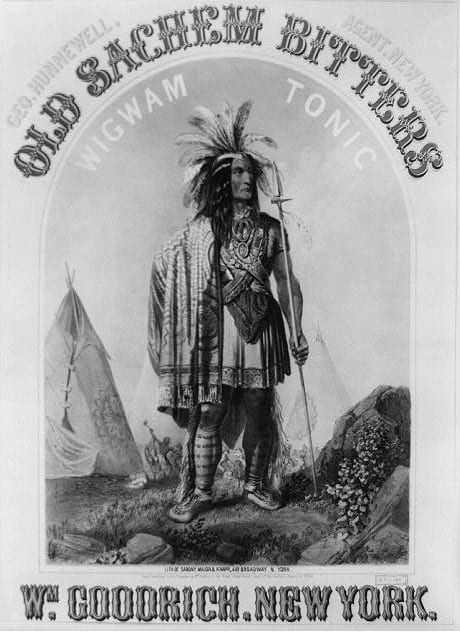
Old Sachem Poster

Old Sachem

Label: From an old Indian recipe in possession of the family of the proprietor for upwards of a century is now offered to the public as one of the most healthy and wholesale beverages extant and as a tonic is unsurpassed. Sold by principal grocers, druggists and hotels throughout the union. Endorsed by a professor at Yale College. Drug Catalog: 1871, Schieffelin New Haven Daily News, April 7, 1859, Harpers Weekly, October 8, 1859.

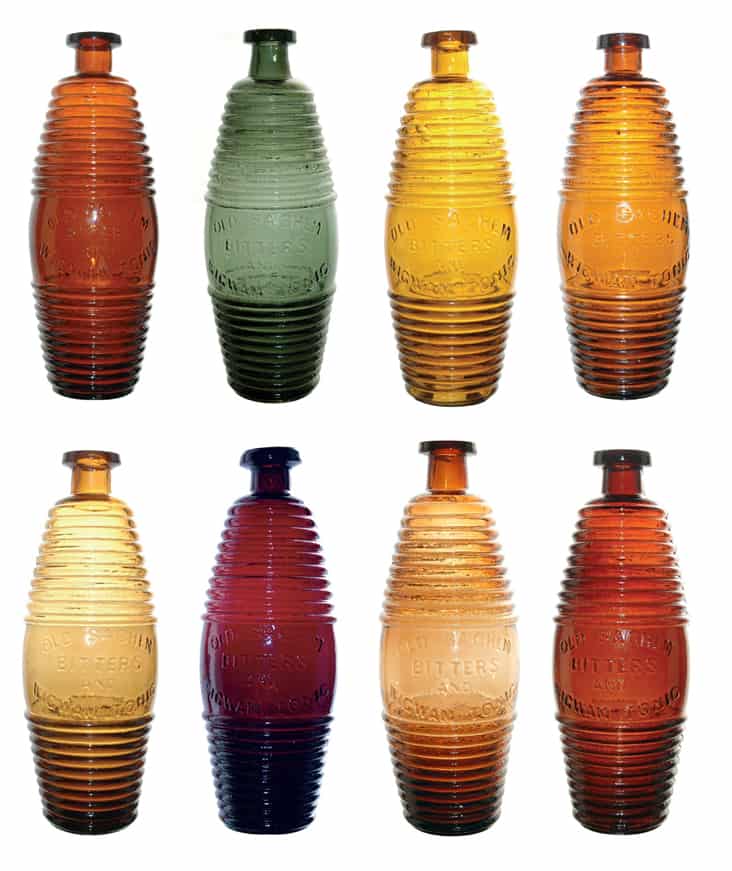
Old Sachem / Bitters / And / Wigwam Tonic is usually about 9 1/2 inches tall with a smooth base. It is also known with a blowpipe pontil in 9 1/2 and 9 3/4-inch heights, as well as a 10 1/4-inch aqua variant with a blowpipe pontil. An array of shades of colors with smooth bases also exist.

According to Dr. Richard Cannon, there is a broadside of Old Sachem Bitters and Wigwam Tonic (pictured above), which has been reproduced. It pictures a stern Indian Chief who appears to be very strong and armed for battle. There’s an Indian village in the background with warring Indians and settlers on the outskirts. Above, it gives Geo. Hunnewell, Agent, New York, and below, Wm. Goodrich, New York. Just under the picture in small print is Lith. of Sarony, Major & Knapp, 449 Broadway, N. York. Also in cursive writing in the lower margin is Deposited in Clerk’s Office, Southern Dist., New York, Aug. 5, 1859 and then stamped 25 Nov. 1859.

Apparently George Hunnewell was not the same person as John L. or Joseph W. Hunnewell of Boston who began to put out Hunnewell’s Tolu Anodyne and Universal Cough Remedy in the 1840s. We know that William Goodrich was the proprietor and was located at 145 Water Street. Old Sachem Bitters & Wigwam Tonic was advertised in April, 1859. I do not know how early the product appeared, but probably earlier that 1859. Merrick and Moore Company was in control of the brand when they appeared in the New Haven, Conn. City Directories, 1864-1867. Mr. Merrick resided in several of the local hotels during this period.

Six Old Sachem Bitters

Old Sachem Bitters Color Run - Meyer Collection

Posted in Bitters, Collectors & Collections, Color Runs, Figural Bottles | Tagged , , , , , , , | 1 Comment

C H Atwoods – Neat Bitters Bottles with Fluted Necks

CH Atwood (Color F)

C. H. Atwood – Neat Bitters Bottles with Fluted Necks

Atwood’s Quinine Tonic Bitters

05 April 2011 (R•081818) (R•090719)

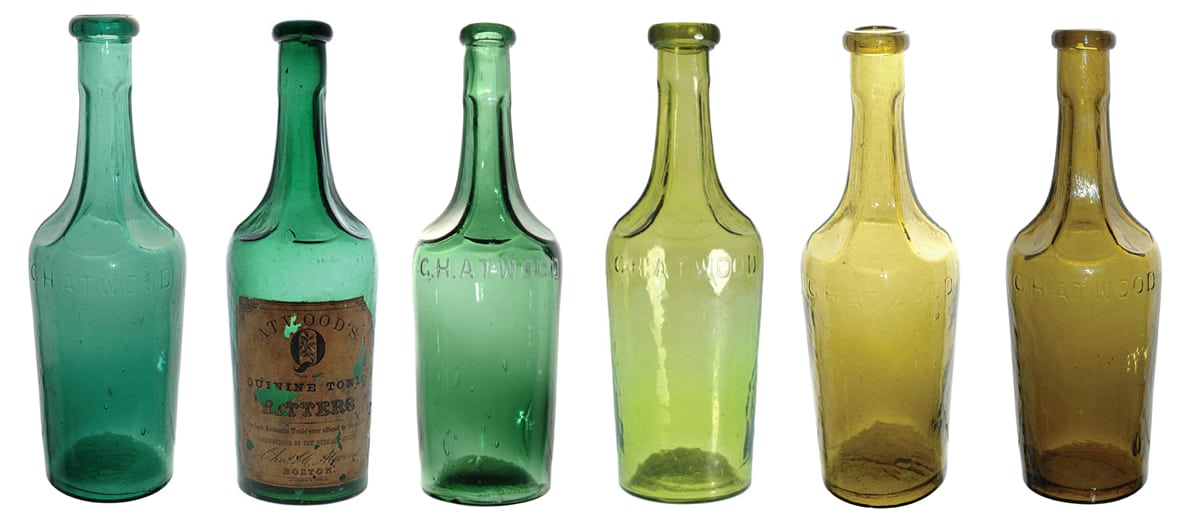
Apple-Touch-IconAThe C. H. Atwood bottles do not get much attention because they are not embossed with the word “bitters”. This doesn’t concern me the slightest. Over the past years, I have managed to put together a color run starting with three bottles I picked up in the Bottles and More, Galleria Auction XXI in April 2007.

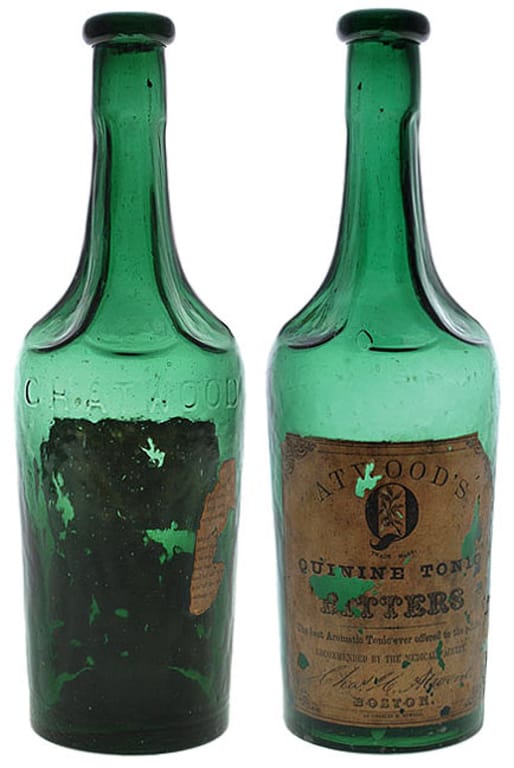
Produced in Boston by Charles H. Atwood from 1860 – 1875, the quart bottles are round and about 10-1/2″ tall though height varies. They have fluted necks and nice applied mouths. The colors are very desirable and the bottles usually have a lot of glass character and presence. They are great window bottles too. I recently added two new bottles to my color run from Glass Works Auction 91 in March 2011, including the spectacular labeled example pictured above.

As this post was updated in 2018, I have added two, smaller half-pint size examples to my collection which are pictured further below. One is dark puce while the other is green. The puce example has no C H Atwood embossing while the green example is embossed C H Atwood, Boston.
Atwood’s Quinine Tonic Bitters color run – Meyer Collection

Atwood’s Quinine Tonic Bitters examples – Meyer Collection

The Carlyn Ring and W.C. Ham listing in Bitters Bottles is as follows. As you can see, the listing needs to be updated.

The new listing in Bitters Bottles Supplement 2:

A 111.5 L … Atwood’s Genuine Quinine Tonic Bitters
// C. H. ATWOOD //
Atwood’s (Q Trade Mark) Quinine Tonic Bitters, The Best Aromatic Tonic ever offered to the public. Recommended by the Medical Faculty. Signature Chas. H. Atwood, Boston. Reverse label directions.
10 x 2 1/2
Round, fluted neck, RC, green, yellow, olive
See sA 115.5
A 111.6 // C. H. ATWOOD / BOSTON //
Embossed copy surrounded by elongated embossed lozenge border)
7 x 1 ¾
Round, fluted neck, RC, green, puce

Charles Henry Atwood

Charles Henry Atwood was probably born around 1822 in Massachusetts. We find him first listed as a druggist selling ‘Fluid Extract of Sienna’ in 1845 which was most likely a predecessor of his Atwood’s Quinine Tonic Bitters. Quinine was first isolated in 1820 from the bark of a cinchona tree. Peruvian bark extracts have been used to treat malaria since at least 1632.

C. H. Atwood would sell his Quinine Tonic Bitters from about 1860 to 1871. This is when his bottles were made and used. He used the letter “Q” with a cinchona tree stem in the middle for a logo. Atwood was listed many times in Boston city directories as a chemist whose signature can be found on each bottle label. He is also listed as a highly respected importer of choice chemicals and medicines. Besides the fluted bottles, there is also an aqua medicine bottle embossed Atwood’s Quinine Tonic Bitters.

Atwood will sell the rights to his bitters to Alvah Littlefield who was listed as the proprietor of C H Atwood’s Quinine Tonic Bitters in 1871. He operated a drugstore within and under the United States Hotel in the 1870s. Littlefield’s wife would later hang herself in 1875 on a chamber door. Apparently she had become “deranged” as news reports stated.

Charles Atwood died on 12 May 1877 in Boston. There is reference to his bitters surviving and being sold as late as 1906.

There are a number of sources online (one listed below) that state that Moses Atwood was the inventor of the Atwood’s Quinine Tonic Bitters. These reports ignore Charles Henry Atwood. Since C.H. Atwood was a chemist and druggist, I’m going to give him the benefit of doubt until I can dispel or prove the connection.

Read: Moses Atwood – Atwood’s Jaundice Bitters – Georgetown, Massachusetts

Read: Manhattan Medicine Company v. Wood

The Manhattan Cookbook

[Excerpt] This volume in the American Antiquarian Cookbook Collection, published in New York in 1877, is a cookbook, patent medicine advertisement, and medical manual all combined in one small volume published by the manufacturer of a well-known and widely used nineteenth century home remedy, Atwood’s Bitters.

Historical records assert that in 1840, Moses Atwood of Boston created what became a widely used and very popular patent medicine, Atwood’s Quinine Tonic Bitters. Rights to the product were eventually bought by John Henry, who added another remedy, Dr. Roger’s Compound Syrup of Liverwort, Tar & Canchalagua, to his collection and created the Manhattan Medicine Company to manufacture and sell the concoctions.

The Manhattan Cook-Book is a small volume that is essentially a promotional flyer for the company’s patent medicines. Recipes and recommendations for hair care and personal toiletry are threaded throughout with patent medicine ads, so that page 1 of the content touts Dr. Rogers’ Compound Syrup, and page 2 lists “receipts” for Tea Biscuit, Delicious Lemon Jelly Cake, and Rusks. Every page is headed by an exhortation to, “Take Spalding’s Pills for Costiveness,” “Take Dr. Johnson’s Bitters for Indigestion,” “Use Phalon’s Hair Invigorator for the Hair,” and many more. Recipes for tapioca, coffee cake, and strawberry tartlets are sandwiched in between medical advice (using many of the medicines advertised) for whooping cough, asthma, pneumonia, and other diseases. This charming example provides fascinating insight into contemporary cooking, medicine, and lifestyles.

This edition of The Manhattan Cook-Book by the Manhattan Medicine Company was reproduced by permission from the volume in the collection of the American Antiquarian Society, Worcester, Massachusetts. Founded in 1812 by Isaiah Thomas, a Revolutionary War patriot and successful printer and publisher, the Society is a research library documenting the life of Americans from the colonial era through 1876. The Society collects, preserves, and makes available as complete a record as possible of the printed materials from the early American experience. The cookbook collection includes approximately 1,100 volumes.

The Manhattan Medicine Company was founded by John Henry in 1877 to manufacture and sell various patent medicines to which he had acquired rights including Atwood’s Quinine Tonic Bitters, Dr. Rogers’ Syrup of Liverwort, Tar, and Canchalagua, Phalon’s Hair Invigorator, Spaldings Cephalic Pills, and many other popular remedies of the day.

Select Timeline:

1845: Advertisement for Fluid Extract of Senna, Mr. Charles H. Atwood, druggist, Green Street, Boston – Boston Medical and Surgical Journal, August 1845

1860: Advertisement Atwood’s Quinine Tonic Bitters (below) – Green Mountain Freeman, Thursday, September 6, 1860

1860: Advertisement Atwood’s Quinine Tonic Bitters (below), For sale by Chas. H. Atwood, 19 Central Street, Boston – Aurora of the Valley, Saturday, November 3, 1860

1861: Atwood’s Quinine Tonic Bitters advertisement (below) – The Daily Green Mountain Freeman, Saturday, August 31, 1861

1864: C.H. Atwood, Drugs, Medicines, 19 Central – Boston, Massachusetts City Directory
1870: Charles Atwood, Wholesale Druggist, Age in 1870: 50, Birth Year: abt 1820, Birthplace: Massachusetts, Home in 1870: Somerville, Middlesex, Massachusetts, Inferred Spouse: Sarah Atwood (40), Inferred Children: George S. Atwood, 20 – United States Federal Census
1870 & 1875: C.H. Atwood, Chemist, 14 Central Wharf – Boston, Massachusetts City Directory
1871: Advertisement Atwood’s Quinine Tonic Bitters (below) – New England Farmer, Saturday, April 15, 1871.

1871: Advertisement Atwood’s Quinine Tonic Bitters (below). Alvah Littlefield, Proprietor – New England Farmer, Saturday, June 24, 1871.

Posted in Advertising, Auction News, Bitters, Collectors & Collections, Color Runs, Druggist & Drugstore, History, Medicines & Cures, Tonics | Tagged , , , , , , , , , , , , , , , , , , , | Leave a comment

CD 726 Insulator tops Pole Top Discoveries 64 Auction

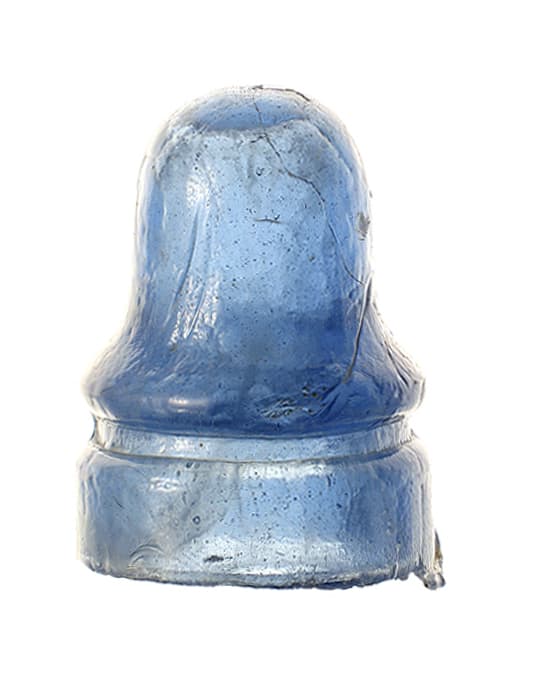
This beautiful and sexy piece of glass is a CD 726 Insulator that sold for big dollars in the recent Pole Top Discoveries Auction #64 conducted by Ray Klingensmith. Ray wrote it up as follows:

Lot #227 ….. CD 726 ….. Unmarked. ….. Milky violet blue. ….. This example was the only CD 726 known in violet blue until recently, when two more surfaced, not far from Quebec City.

CD 726 Insulator

CD-726 Beautiful and sexy piece of glass

The CD 726 has been found in widespread areas along Canadian railways, ranging from Ontario to the Maritime Provinces. Some have surfaced on railways which were completed in 1869 and 1870, indicating this style was likely produced into the late 1860’s and possibly the early 1870’s.

They have been found in a rainbow of exotic colours, ranging from the more readily available aquas, various blues, a couple green shades, purple and cranberry red. Blackglass purple and a couple variations of blackglass olive and olive amber have also been reported.

The Canada Glass Works, in what is now Hudson, Quebec, is known to have produced threadless insulators including some CD 726’s. The company manufactured various types of glassware including ornamental wares such as lamps, thus utilizing a wide range of glass colours. Pioneer insulator collector Jack Hayes, of Pakenham, Ontario excavated the old factory site decades ago, finding fragments of various threadless styles, including the CD 726.

An abundance of milky opaque impurities in the glass add great beauty. Overpoured glass at the base creates a wonderful tilt! Excellent condition. Ex Dean Axelson, ex John Dorge. Dale Evoy collection.

Opening Bid: $6,500   Winning Price: $ 20,160.00 (including 12.0% buyer’s premium)

Posted in Auction News, Insulators | Tagged , , , , , , , | Leave a comment

John Roots Bitters – Gorgeous Green Colors

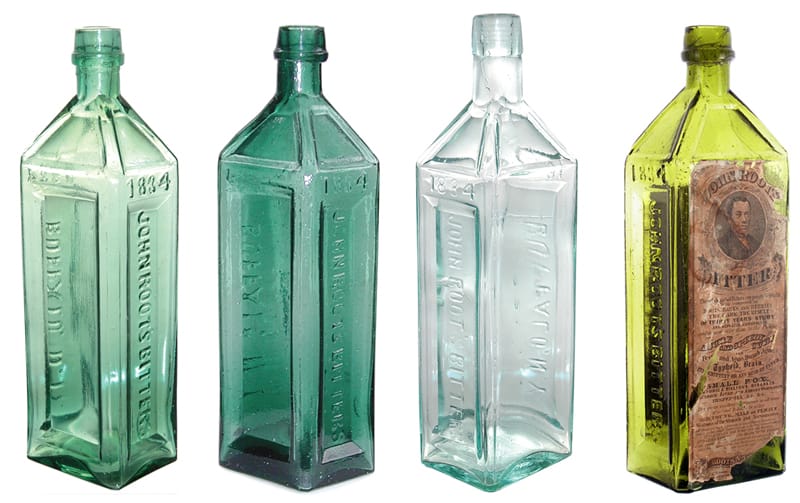
John Roots Bitters Color Run

John Roots Bitters – Meyer Collection

John Roots Bitters – Gorgeous Green Colors

Buffalo, New York

04 April 2011 (R•Jan13) (R•120513) (R•103014) (R•032715)

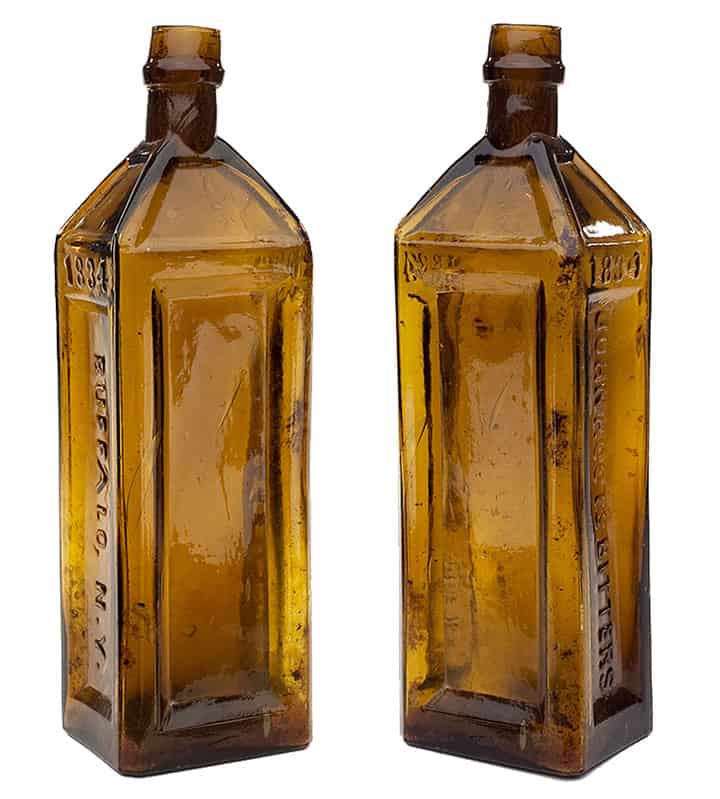
Apple-Touch-IconAThe recent Glass Discoveries Auction #64 in March had a wonderful example of a John Roots Bitters in a strong bright olive green color. There were also original labels. I inspected this bottle at the FOHBC Wilmington, Ohio National Show in 2010 when Ray Klingensmith gave me a early preview. There was also another very similar example at the show that had just been dug that had been brought to my attention. Unfortunately I did not get this bottle to add to my color run (left three bottles). I’m in the hunt though. The Glass Discoveries lot is listed below:

Lot #115   RH R-90.4   1834   JOHN ROOT’S BITTERS   1834   BUFFALO, N.Y. Bright olive green. 10-1/8” Semi cabin form. Smooth base. Circa 1866-1875. Original labels, front and back. An extremely rare and attractive color variant that is unlisted in Ring-Ham. All the more desirable with the original labels! Bottle in excellent condition. The paper thin cover glass on a base corner bubble is partially incomplete. Labels have some wear and loss, but mostly intact. Rare!!! Bob Watson collection. Opening Bid: $5,000. Winning Price: $ 12,320.00 (including 12.0% buyer’s premium)

Illustrated Buffalo: the queen city of the lakes

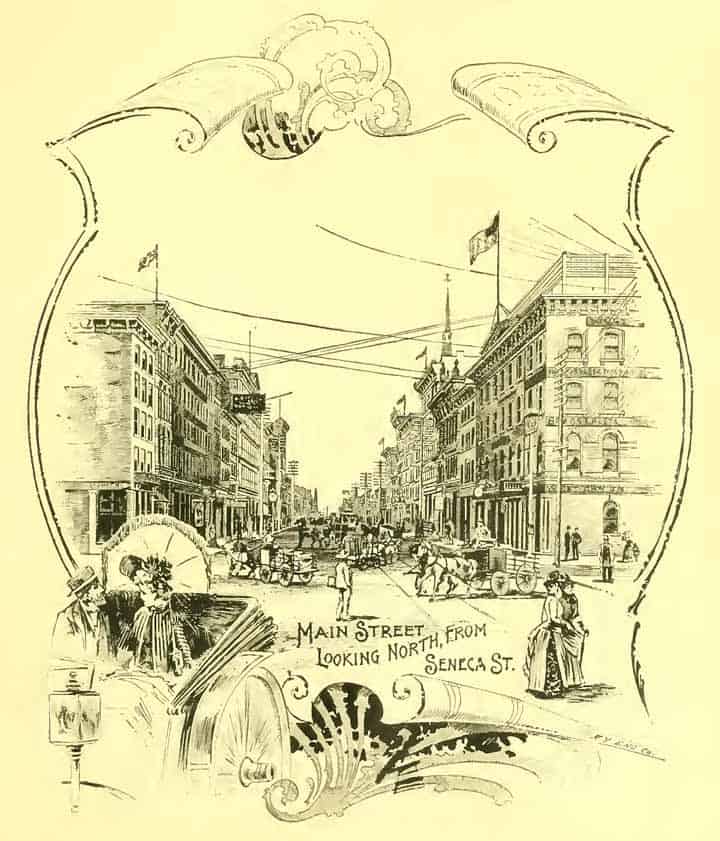
Main Street Looking North from Seneca Street – Illustrated Buffalo, Queen City of the Lakes, 1890

John and Francis Root

Francis Root, manufacturer of John Root’s Bitters. No. 308 Seneca Street.

The establishment where these bitters are manufactured was founded as far back as 1834 by the man whose name they bear, at No. 292 Seneca Street, and since that time the reputation of this infallible remedy has steadily increased. In 1874, Mr. Francis Roots, on the death of the founder of the business, succeeded to the latter, and by his ability and experienced energy has proved himself worthy of the house he was at that time called on to manage. In 1890, the growing demand for its products necessitated the removal of this establishment to the larger and more commodious premises it now occupies at No. 308 Seneca Street. Unlike many other preparations generally classed under the name of bitters, these are a purely medical compound prepared soley from vegetable sources, and contain nothing that is not salubrious, cleansing and restorative. They cure fever and ague, dyspepsia, jaundice, liver and kidney…. typhoid fever, and is highly recommended for the absolute purity and tonic effects. The sale of these goods is very large, extending all over the United Stales. The manufacturing department is under the immediate supervision of the proprietor, whose long experience and ability are sure guarantees of the excellence of its products. Although the house is constantly in receipt of thousands of certificates to the value of these bitters as a never-failing remedy, yet it has always followed the policy of the bitters speaking for themselves, and the immense sales may testify to the great confidence the public has in them. Mr. Root, like his predecessor is a Canadian by birth but has been a life-long resident of Buffalo where he is held in high esteem for his honorable and upright dealings, and his many personal qualities. All orders entrusted to him receive prompt and careful attention and no industrial house in the state enjoys a greater popularity with the trade generally.

Reference: Illustrated Buffalo – Queen City of the Lakes, 1890

Roots_The_Leavenworth_Times_Wed__Sep_1__1869_

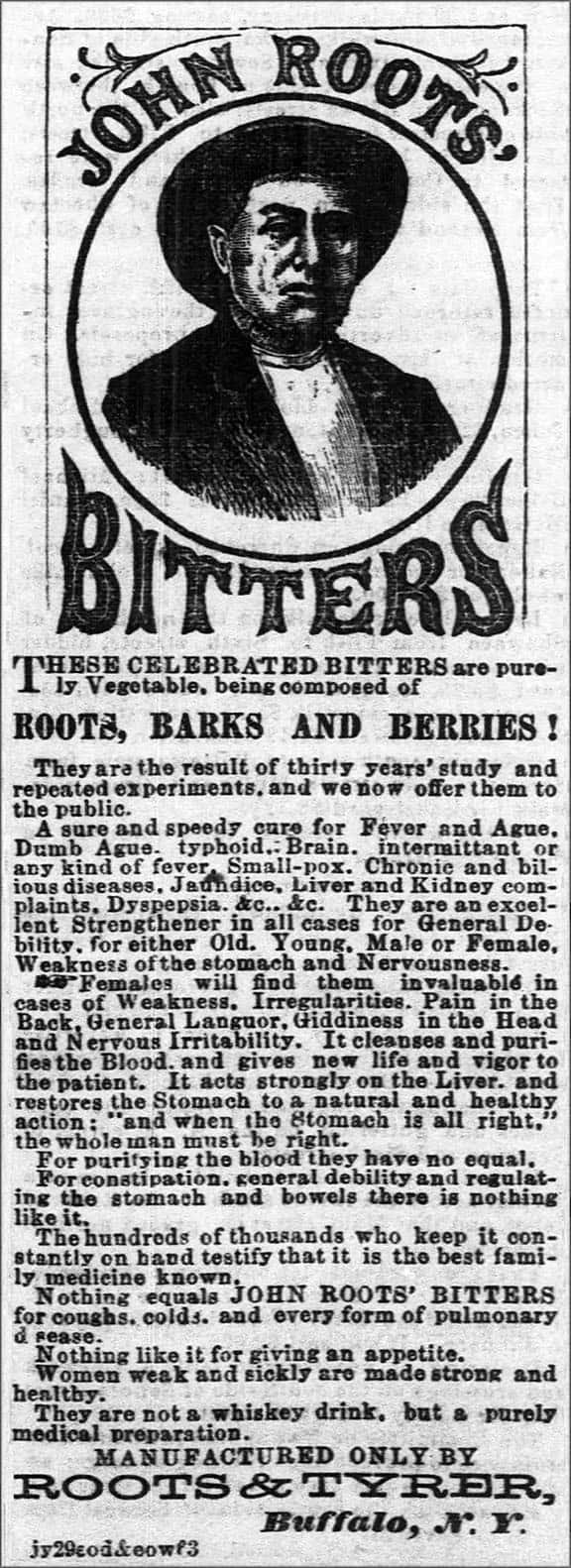
John Roots Bitters advertisement – The Leavenworth Times, Wednesday, September 1, 1869

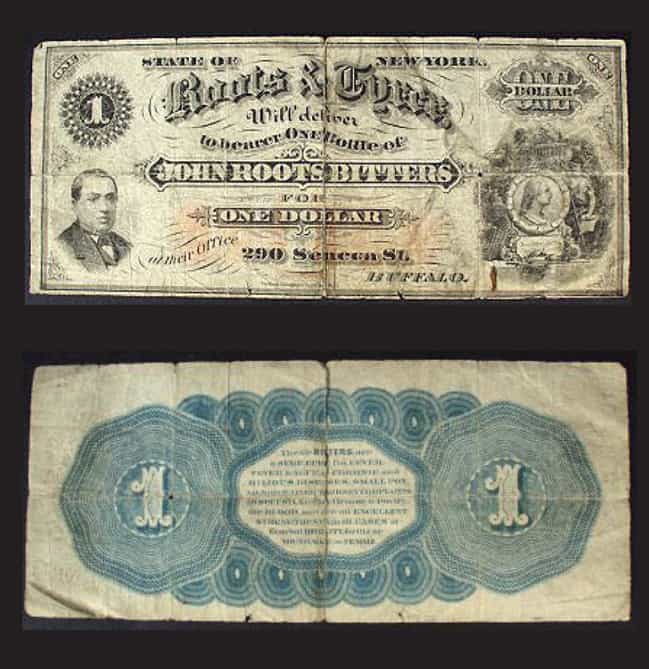
Depicted below is a nice John Roots Bitters Advertising Note I picked up on eBay.

John Roots Bitters Note

John Roots Bitters Note – Meyer Collection

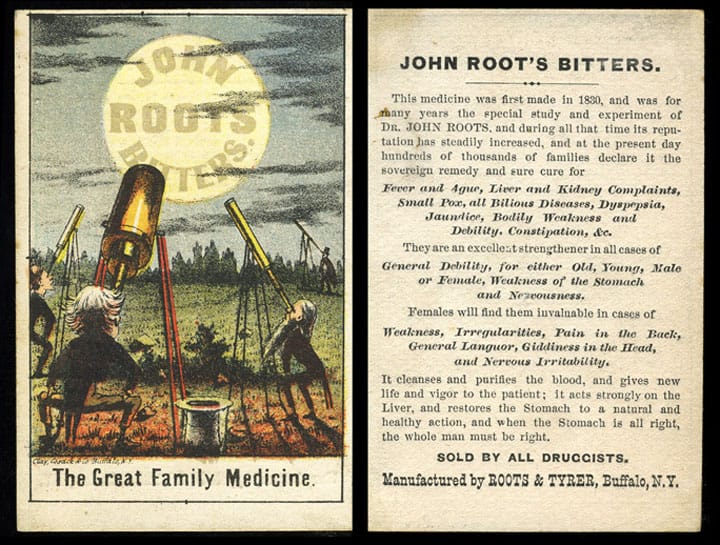
RootsBittersTradeCard

This scarce original early 1870s trade card advertises John Roots Bitters, manufactured by Roots & Tyrer of Buffalo NY. The image is of several astronomers gazing through telescopes at the full moon with the product name on it. Printed by Clay, Cosack & Co., also of Buffalo. ebay (January 2013 addition to post)

RootsAGG13_Lot149

“JOHN ROOT’S BITTERS / 1834 – BUFFALO, N.Y. / 1834″, America, 1865 – 1875. Yellowish honey amber, rectangular semi-cabin, applied sloping collar with flat band – smooth base, ht. 10 1/8”, very near mint; (some in-manufacture crazing lines in the neck and some dried interior contents or residue, most of which would almost certainly soak out). R/H #R90.4. Very rare in amber, and this example has plenty of yellow in it! Note, this example is fresh to the market, discovered at a local auction near the Southern Ohio / West Virginia area. Beautiful color, almost a butterscotch tone. And, as mentioned, the interior appears to have dried medicine or contents that should easily soak out. – American Glass Gallery Auction #13

Read: Very Scarce Amber John Roots Bitters found by Jack Stecher

Posted in Advertising, Auction News, Bitters, Bottle Shows, Collectors & Collections, Color Runs, Figural Bottles | Tagged , , , , , , , , , , , , | 2 Comments

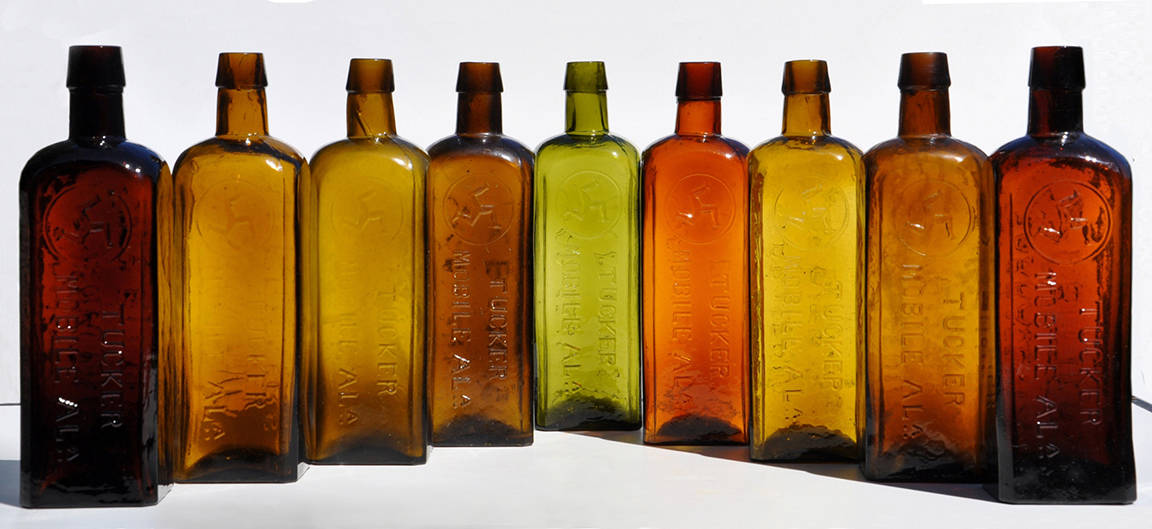
Sarracenia Life Bitters and the Triskelions

Sarracenia Life Bitters Trio

Sarracenia Life Bitters (Variants and Sample) – Meyer Collection

Sarracenia Life Bitters and the Triskelions

04 April 2011 (R•060517) (R•040420 – Vining Update)

Flag_of_Sicily.svg

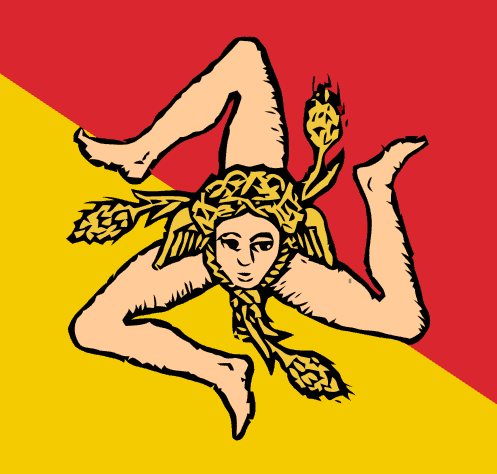
A triskelion or triskele is a motif consisting of three interlocked spirals, or three bent human legs. Both words are from Greek “τρισκέλιον” (triskelion) or “τρισκελής” (triskeles), “three-legged”, from prefix “τρι-” (tri-), “three times”[2] + “σκέλος” (skelos), “leg”. Although it appears in many places and periods, it is especially characteristic of the Celtic art of the La Tène culture of the European Iron Age. [Wikipedia] Triskelion on Flag of Sicily above.

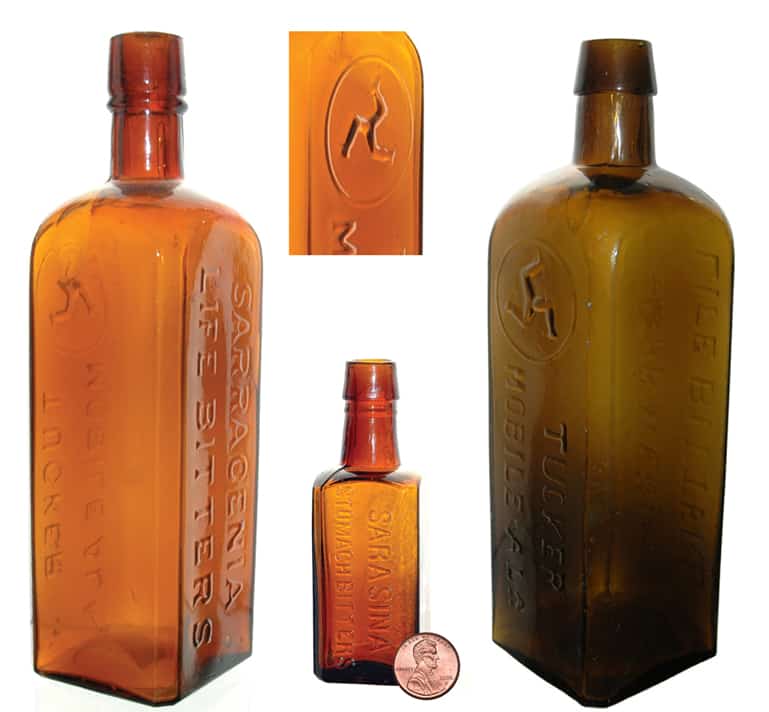
Apple-Touch-IconAThe Sarracenia Life Bitters is an interesting square coming from Mobile, Alabama. The bottles is embossed with SARRACENIA LIFE BITTERS, TUCKER and MOBILE, ALA. There is also an embossed outline of a circle on one of the bottle sides with a Triskelion, which is a motif of three legs joined in the center.

The S 34 variant is Rare and the legs run clockwise. The S 35 variant is older and the legs run counter clockwise. There are also two dots under the ‘A’ of Alabama. I have displayed a picture of both from my collection including my extremely rare sample bitters which does not have the Triskelion.

I wonder, where are these legs running, why this motif and why were the legs reversed in the later variant?

The Carlyn Ring and W.C. Ham listing in Bitters Bottles is as follows:

S 34 – SARRACENIA LIFE BITTERS Circa 1875 – 1879,
SARRACENIA / LIFE BITTERS // f // motif 3 legs joined in center enclosed in a circle // TUCKER / MOBILE ALA // f //   9 1/4 x 2 5/8 (7) 3/8   Square, LTCR, Shades of Amber, LTC and LTCR, Applied mouth, Rare. Legs go clockwise.
S 35 – SARRACENIA LIFE BITTERS Circa 1873 – 1875
SARRACENIA / LIFE BITTERS // f // motif 3 legs joined in center enclosed in a circle // TUCKER / MOBILE ALA // f //   9 1/4 x 2 5/8 (7) 3/8   Square, Amber, Yellow green, Lime green, Yellow and Apricot, LTC and LTCR, Applied mouth, Rare. There are two dots under the A of ALA. Legs go counterclockwise. Older variant.

Note: Joseph Tucker was listed as a Doctor and manufacturer of Sarracenia Life Bitters from 1873 – 1879. The Mobile Daily Register. July 2, 1871. Drug Catalog: 1883 Schieffelin.

Sarracenia Life Bitters_Ad1

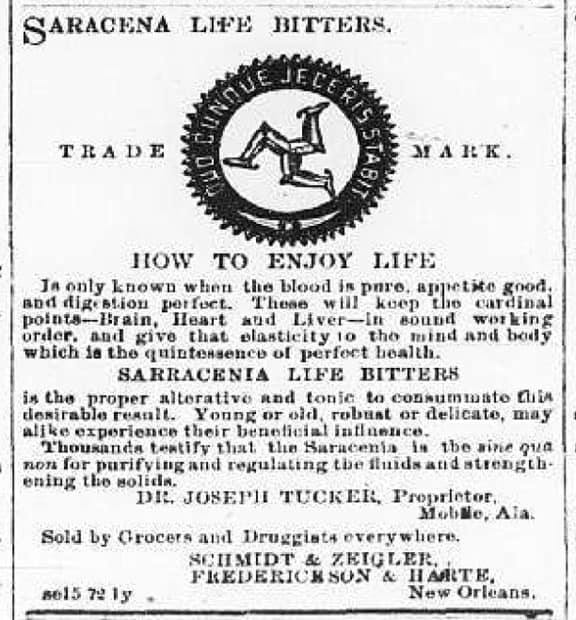
Sarracenia Life Bitters advertisement – The Morning Star and Catholic Messenger, May 04, 1873 – New Orleans


Color run of Sarracenia Life Bitters from Mobile, Alabama. From the Rod Vining collection.

According to Rod Vining, Instead of “clockwise and counter clockwise variety”, you only need to look at the tops. The “Tuckers” that have the long tapered collar with NO ring underneath are the ones that come in a wide range of colors. This is the OLDER, original mold, and you can find nicely whittled examples. The NEWER mold seems to always have a long tapered collar with a ring underneath, or a “whiskey” type top. They only come in two shades: standard amber, and a little lighter standard amber, and are mostly just “slick” with no whittle at all. In comparison, they are just not as photogenic!

[04 April 2020] Here are the new Sarracenia Life Bitters photos with double the number of bottles than the previous image. Generous lighting with no flash. Photo numbers 1871 (top) and 1874 (middle) are all the older variants, while photo 1876 (bottom) has two older on the ends with four newer variants in the center. These were all produced between 1872 and 1879. The newer variety with the whiskey top are almost always just shades of amber to yellow amber. The legs run the opposite direction, and they are not as crude as the others. While some of the color differences are minor, others are eye-popping. I am still trying to get them all tumbled up as I have the time. – Rod Vining
Posted in Bitters, Collectors & Collections | Tagged , , , , , , , | 1 Comment

Two Great Bottles – Glass Discoveries Auction #64

Glass Discoveries Auction #64

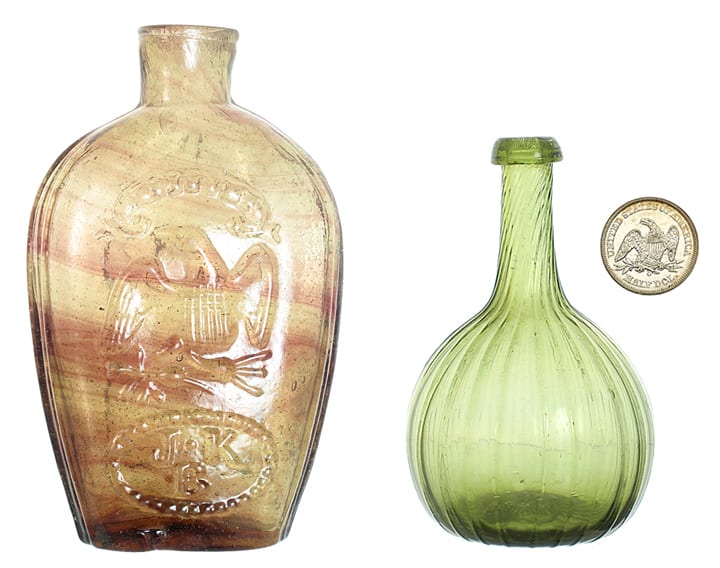
GIV-3 and Midwestern Glob - Fuss Collection

On Sunday 20 March 2011, Glass Discoveries completed their 64th Auction. The insulator auction closed a few nights later.

Sandor Fuss stated in Baltimore in early March that he was not going to participate in the auction. To my surprise, I received an email from him after the auction with the attached pictures for two lots he had won. I think these are rather extraordinary beautiful and rare bottles. Way to go Sandor! Can’t wait to see them on my next trip to Denver.

Lot #1   GIV-3   (Eagle motif)   JKB   (Masonic motif) As noted in the catalog…Ginger-ale with burgundy striations. 7”. Pint flask. Pontil scar. Circa 1815-1820. New England. Believed by some to have been produced at a factory in Keene, New Hampshire, but possibly blown at a Boston area works. Wonderful, well pronounced burgundy striations create an eye appealing, and rarely colored beauty! Among the earliest of figured flasks produced in this country, being nearly 200 years old. Some high point wear is visible upon close inspection. Tiny, half-pinhead blemish on the medial rib is either a miniscule flake or tiny open bubble. Either way, it is very minor, and mentioned only for total accuracy! We’ve only seen one other similar flask in recent years, and the other example is believed to be a slightly lighter color with less pronounced striations. A fabulous and desirable rarity in great condition!! Winning Price: $39,200.00 (including 12.0% buyer’s premium)

Lot #63   Miniature 24 Rib Globular Bottle Green. 5-3/16”. 24 vertical ribs. Pontil scar. Midwest America, circa 1815-1835. A much smaller example than is normally seen in both height and circumference. The body is slightly smaller than a baseball. Well pronounced ribs traverse from the pontil mark on the base all the way to the lip. The ribbing remains perfectly vertical all the way to the neck, then turns slightly to the right. From a northeast Ohio collection, and likely surfaced in that area many years ago. A rare size in an equally rare color! Many of the advanced pattern molded glass collections in this country lack an example such as this, including some major museum holdings. Very light haze on the interior might wash out. Some shelf wear on the base and a hint of wear on the ribs. A beauty!!! John Betker collection. Winning Price: $14,560.00 (including 12.0% buyer’s premium)

Posted in Auction News, Collectors & Collections, Flasks, Historical Flasks | Tagged , , , , , , , , , , , , , | Leave a comment