A Graphic Resource on Beer and History

Hi Ferdinand,

Thanks for getting back to me. The graphic highlights a brief timeline of beer and includes some interesting statistics. The piece lives here and you’re welcome to use it as you’d like: http://www.onlinebachelordegreeprograms.com/beer-saved-the-world/

Let me know what you think, I appreciate all feedback.

Thanks!
Peter

Posted in Ales & Ciders, Breweriana, History | Tagged , , | Leave a comment

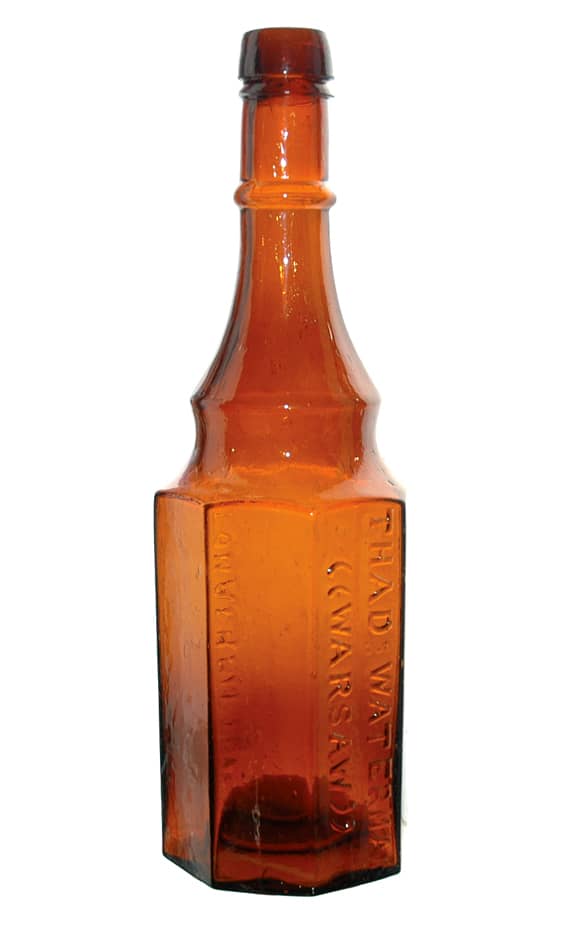
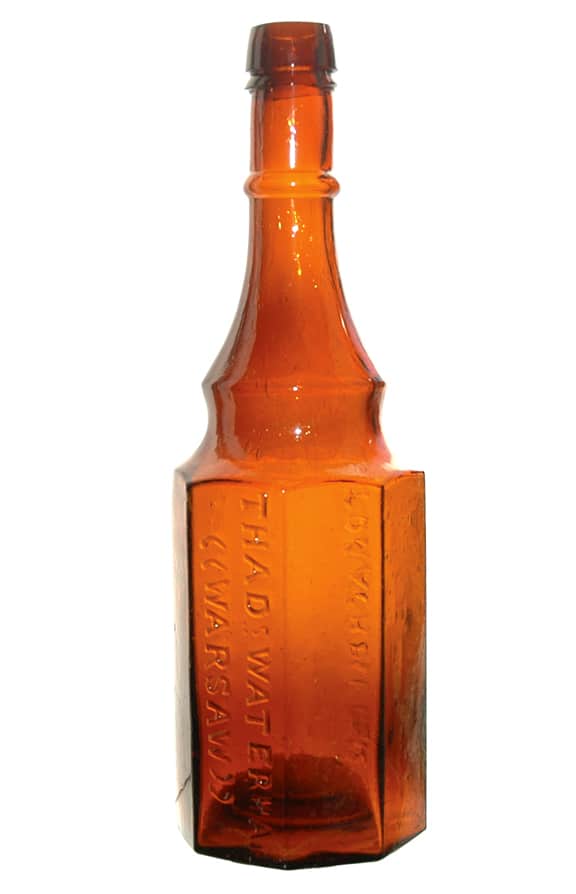
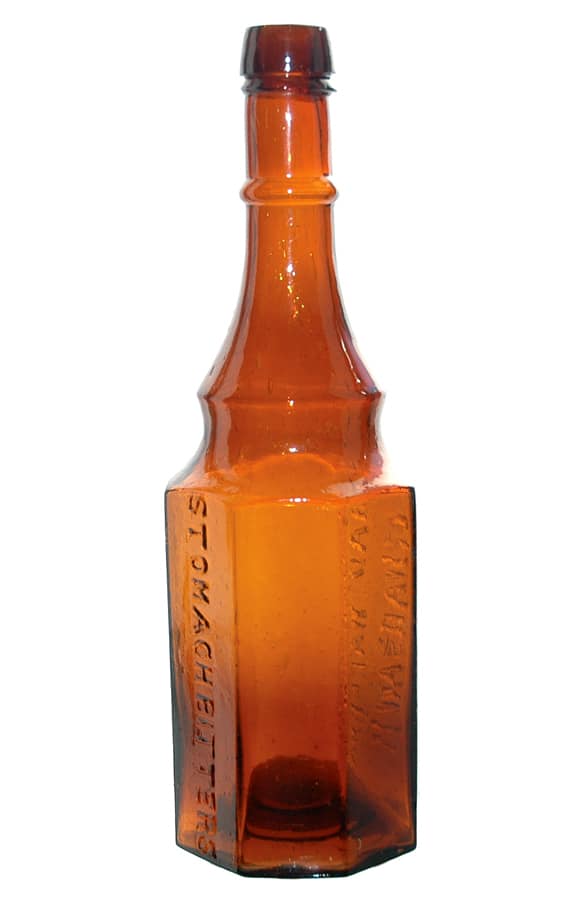
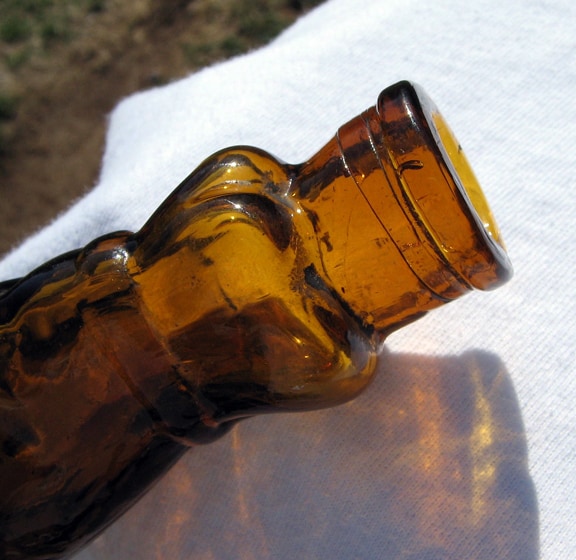
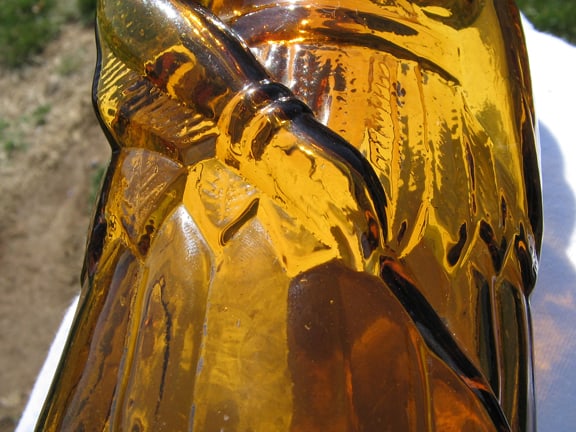
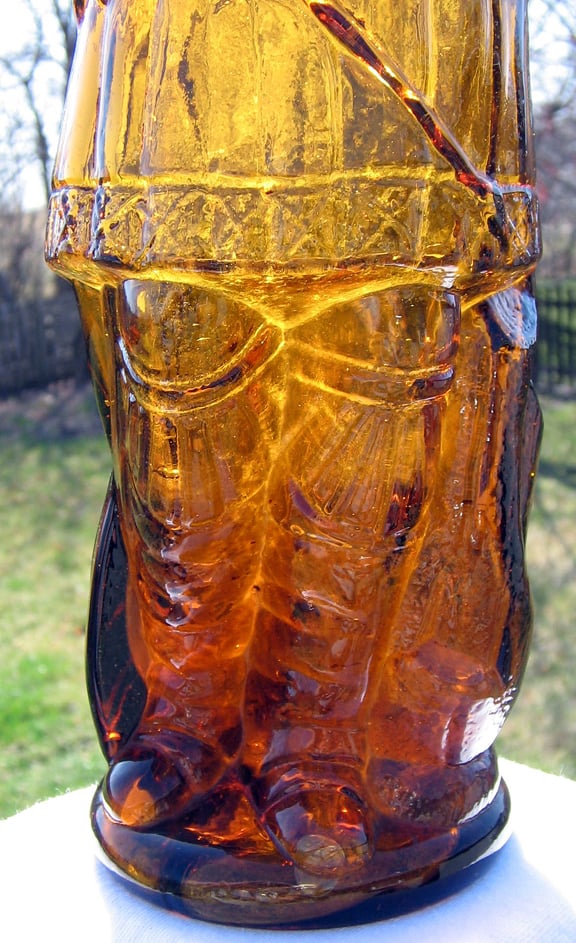
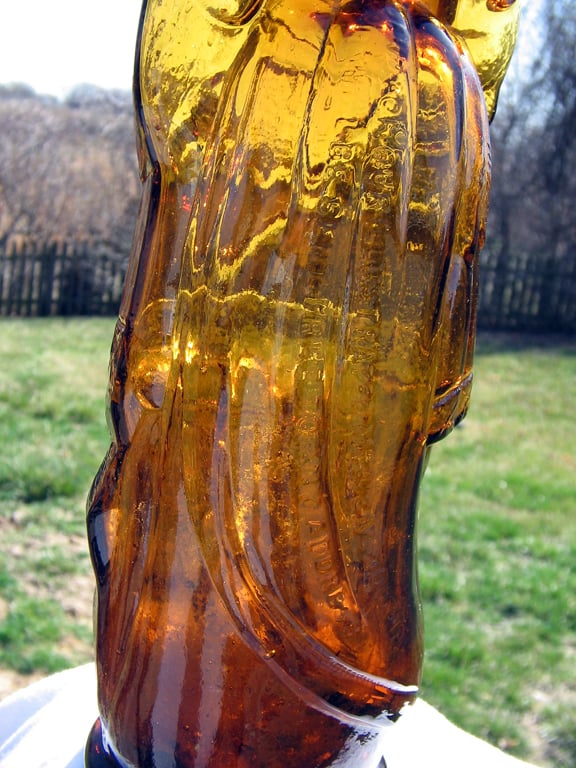
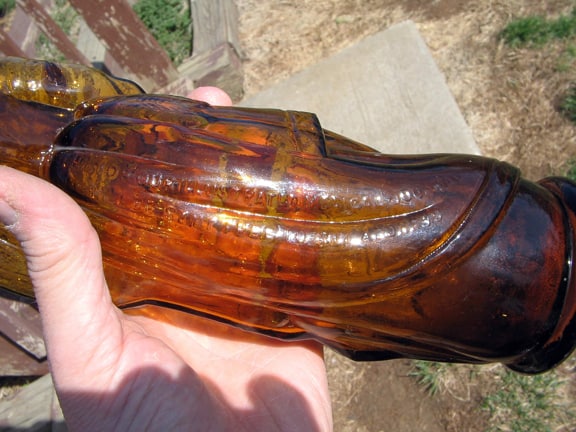
Thad Waterman “Warsaw” Stomach Bitters – Figural Cannon Barrel, Lighthouse or House Roof?

Thad Waterman “Warsaw” Stomach Bitters – Figural Cannon Barrel, Lighthouse or House Roof?

21 March 2012 (R•053015)

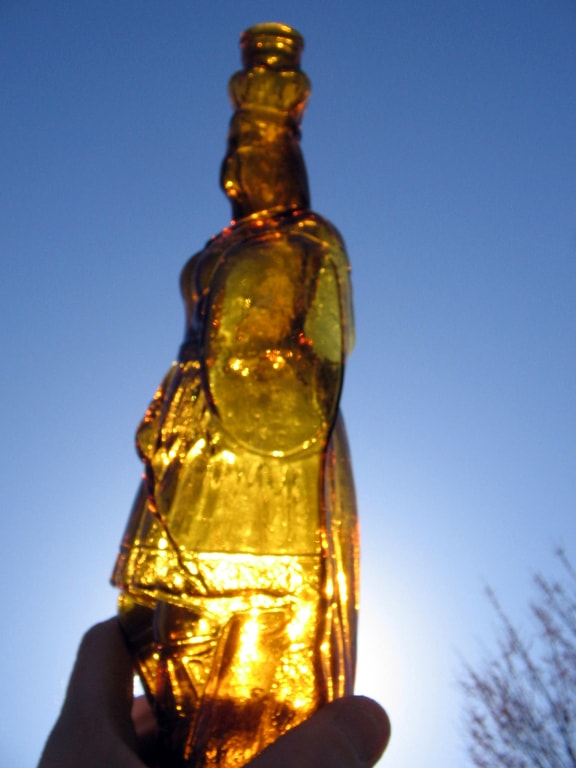
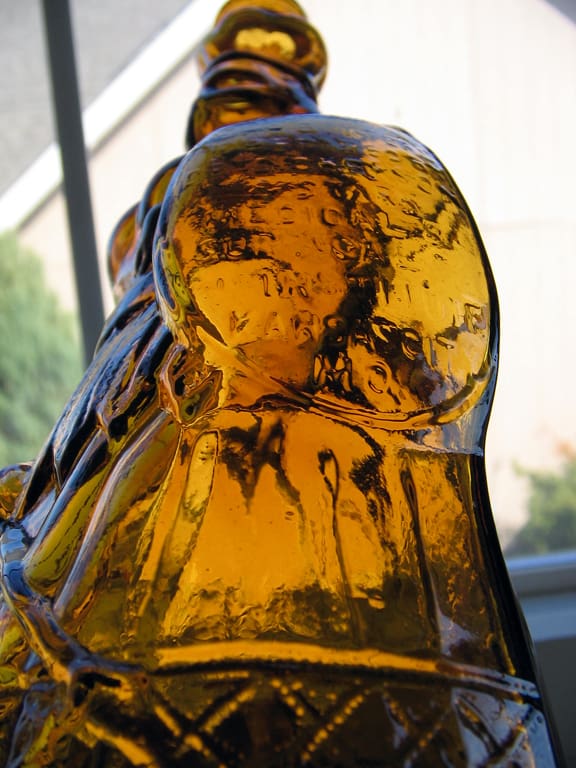
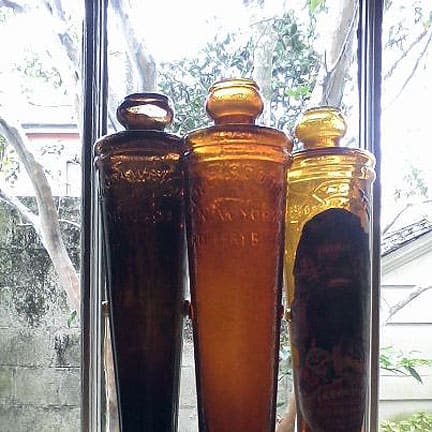
Apple-Touch-IconAToday I add the next bottle to my series of Figural Cannon Barrels or Transitional Cannon Barrels that are thought by some to be reminiscent of other forms such as Lighthouses or Bells. It is tough to say exactly what the bottle designer or client had in mind when making the Warsaw Stomach Bitters without documentary proof such as the patent drawing, label and/or advertising for the subject bottle. Like I said previously with the Castilian Bitters and the Brown’s Castilian, I group these types of bottles together in my collection and call them Transitional Cannon Barrels. See new information below documenting that this product is from New Orleans.

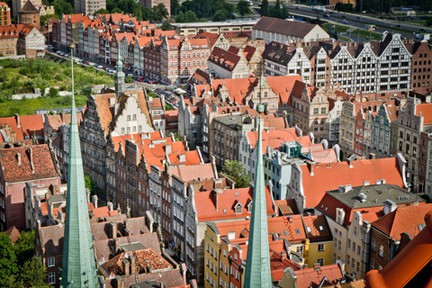
Bottle has a “steep roof” because the Polish population which centered in Chicago had houses with steep roofs so snow would not stick.

Historic City of Gdansk, Poland

I can find very little information on this bottle other than what is printed in Carlyn Ring and W.C. Ham Bitters Bottles. What they note actually adds to the mystery when they say “Bottle has a “steep roof” because the Polish population which centered in Chicago had houses with steep roofs so snow would not stick”. Where did Chicago come from? Polish too? The “WARSAW” name leads us there but why is “WARSAW” with quotation marks?R/H also says an example was found at the mouth of the Mississippi River. Wow.

Example found at the mouth of the Mississippi River.

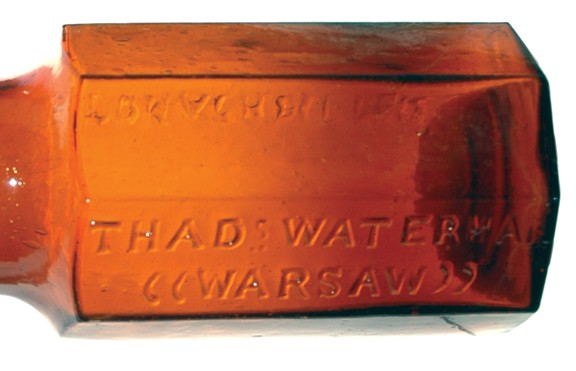
Look at the Quotation Marks around “WARSAW”

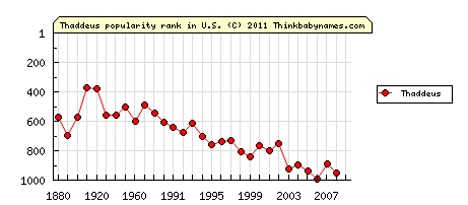
The nickname Thad is typically short for the name Thaddeus which is not a very popular name now as noted on census forms and name popularity charts. It looks like a rather serious decline in popularity from 1920 but possibly higher in 1860 or so.

This is a GREAT bottle and extremely tough to get. As usual, I welcome more information so I can add to and embellish this post.

WarsawStomach_GW

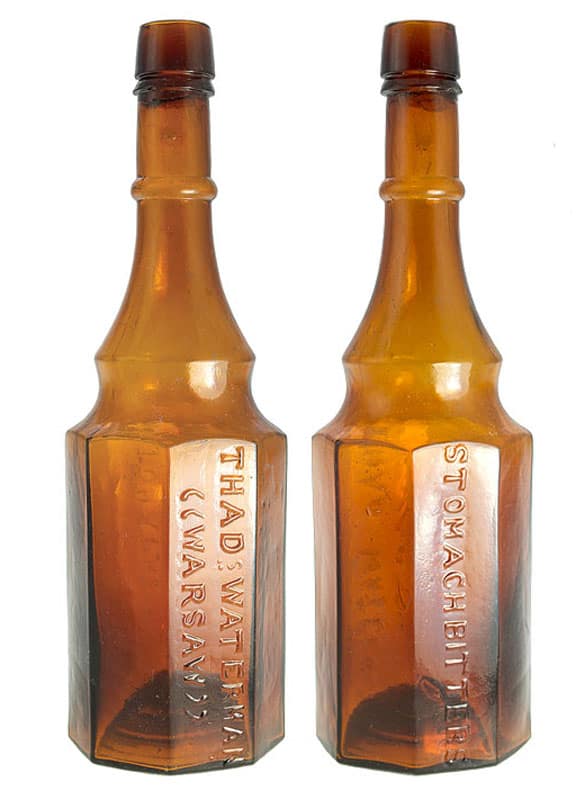
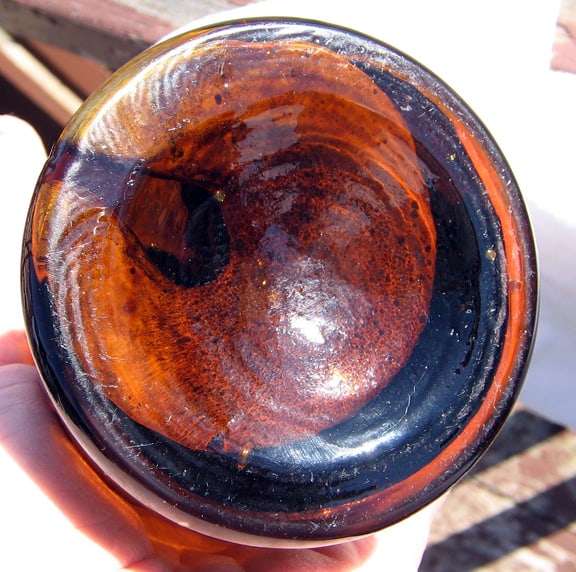
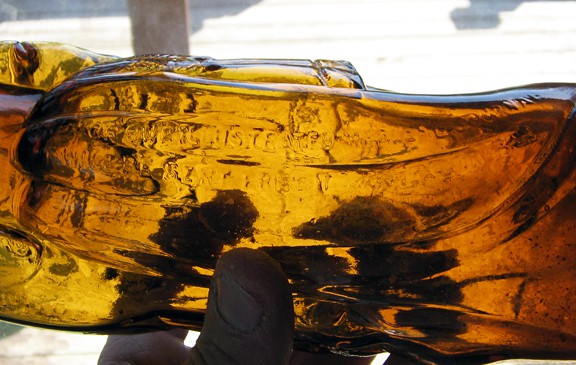
“THADS. WATERMAN / S / ((WARSAW)) – STOMACH BITTERS”, (W-54.5), American, ca. 1865 – 1875, medium amber, 8-sided body, 10 7/8”h, smooth base, applied mouth. This is one of three examples dug in New Orleans about 20 years ago. To our knowledge none have been found since. – Glass Works Auctions January 2013

The Carlyn Ring and W.C. Ham listing in Bitters Bottles is as follows:

W 54.5  THAD WATERMAN WARSAW STOMACH BITTERS, Circa 1870 – 1875
THAD WATERMAN / “WARSAW” // f // f // // STOMACH BITTERS // f // f //
10 7/8 x 3 1/8
8-sided, Amber and green, LTCR, Applied mouth, Very rare
Bottle has a “steep roof” because the Polish population which centered in Chicago had houses with steep roofs so snow would not stick.
Example found at the mouth of the Mississippi River.

NEW MATERIAL (03 September 2012)

Ferdinand,

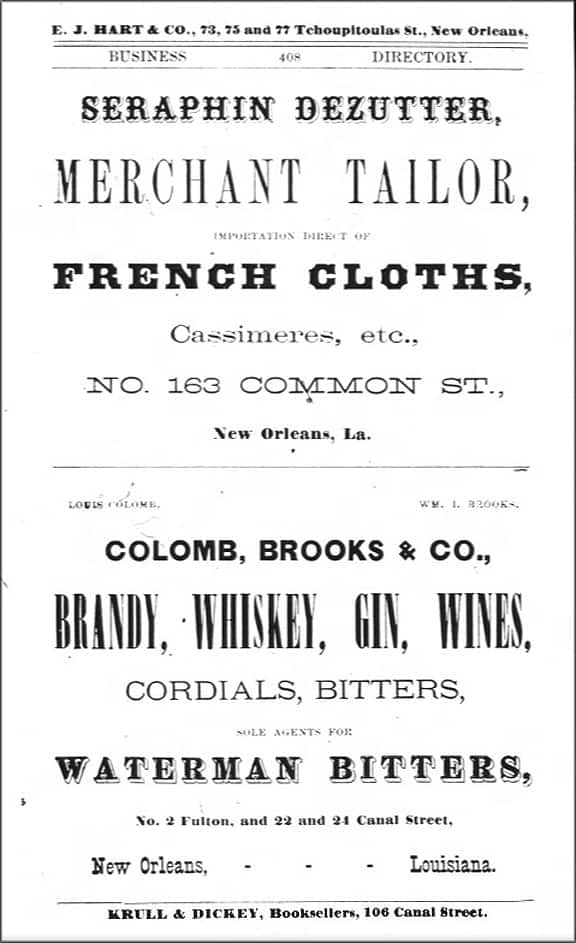
Regarding the Thad Waterman Warsaw Bitters, I suspect it is fitting that the example you show was found at the mouth of the Mississippi since it is a New Orleans bottle. I haven’t sorted out all the details but found enough online to document the product. It appears Thad was a well known liquor dealer in New Orleans. It is not clear why he chose another liquor business (Colomb, Brooks & Co.) to act as agent for the product, but he did. The attached items (see below) give a little insight into the bitters. One is a page from the 1869 New Orleans Directory that certainly alludes to the Warsaw Bitters, since it uses Waterman’s name.

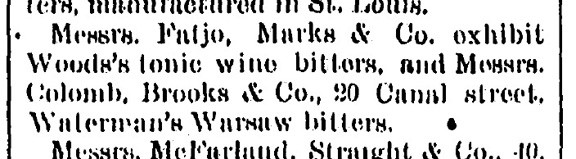
The other attachment (see below), from the New Orleans Times Picayune of April 8, 1869, which is from a long article describing displays at the third annual state fair in New Orleans. Colomb, Brooks & Co. entered a display of “Waterman’s Warsaw bitters.” That about clinches it. I’ll leave it to others to fill in the remaining blanks, for which there are plenty. I am too busy focusing on California bottles and will probably never finish all I want to cover.

Sincerely,
Eric McGuire

WATERMAN BITTERS, 1869 New Orleans advertisement – submitted by Eric McGuire

WATERMAN’S WARSAW BITTERS, New Orleans 1869 exhibition notice – submitted by Eric McGuire

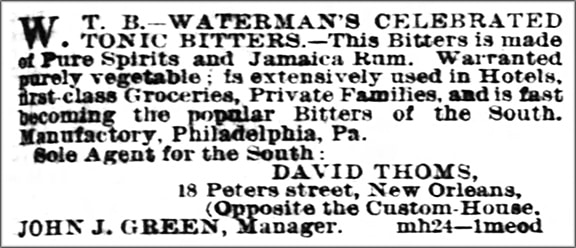
Watermans_The_Times_Picayune_Sun__Mar_24__1872_

W.T.B. Waterman’s Celebrated Tonic Bitters advertisement – The Times Picayune, Sunday, Mach 24, 1872

THAD WATERMAN WARSAW STOMACH BITTERS – Meyer Collection

THAD WATERMAN WARSAW STOMACH BITTERS – Meyer Collection

THAD WATERMAN WARSAW STOMACH BITTERS – Meyer Collection

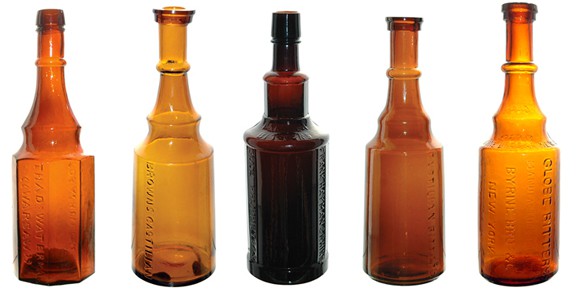
(L-R) WARSAW BITTERS, BROWN’S CASTILIAN, SOL FRANK’S PANACEA BITTERS, CASTILIAN BITTERS and a GLOBE BITTERS – Meyer Collection

Read Further: R. & G. A. Wright – Great Gun Cologne

Read Further: General Scotts Artillery Bitters – The Ultimate Cannon Barrel Figural

Read Further: Tobias Barto and his Great Gun Bitters – Reading, PA

Read Further: Figural Cannon Bottles – J T GAYEN / ALTONA

Read Further: A. M. Bininger & Co. Figural Cannon

Read Further: Sol Frank’s Panacea Bitters – Great Form

Read Further: “the Buchanan Cannons”

Read Further: Brown’s Castilian Bitters – Transitional Cannon Barrel Figural

Read Further: Castilian Bitters – Brown & Embree Proprietors – New York

Posted in Advertising, Bitters, Collectors & Collections, Figural Bottles, History | Tagged , , , , , , , , , , , , , , , , , | 2 Comments

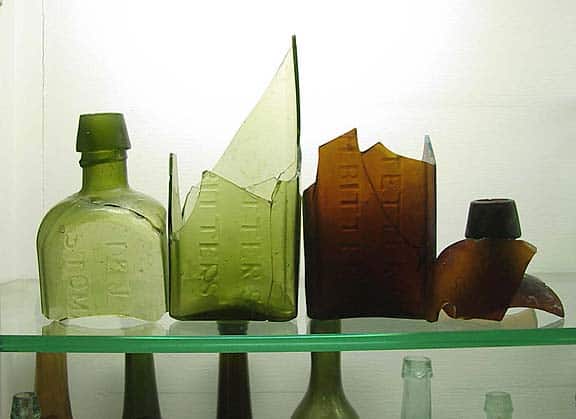
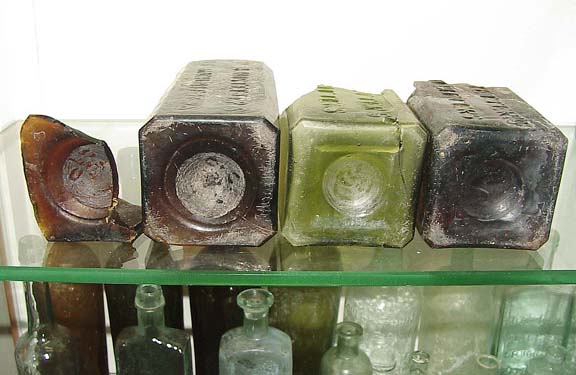
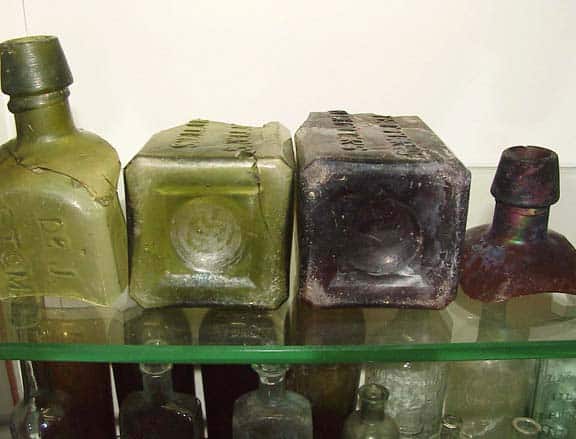
Some Early Hostetter’s Stomach Bitters Shards Dug by Chris Rowell

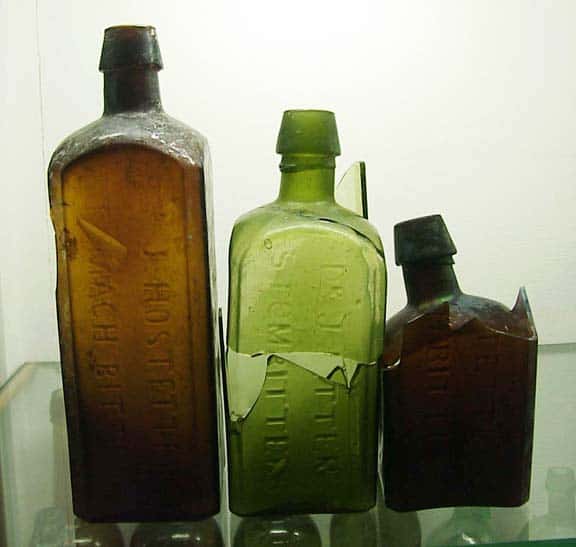
Hostetter’s Stomach Bitters glass shards – Chris Rowell

Some Early Hostetter’s Stomach Bitters Shards Dug by Chris Rowell

20 March 2012

Apple-Touch-IconAI thought I would publish some interesting dialog between big time East Coast digger and collector Chris Rowell and one of the top, if not the top Hostetter’s collectors and experts in our hobby, Richard Siri from the West Coast.

[Chris Rowell] Ferd, We dug a pit today with 5 iron pontiled Hostetter’s Stomach Bitters and sadly they all were smashed. But I wanted to ask, have you ever seen an iron pontiled one in any color other then Amber? I know I have seen many smooth base ones in some nice shades of green. But one of the smashed ones was a great light yellow green with an iron pontiled base. It would have been killer crude and whittled also. I will forward you some pictures of the shards if you want. If you know anyone who is a big Hostetter’s collector that might know if the pontiled ones come in other colors if you could ask them that would be great also. Thanks Chris

 [Ferdinand Meyer] Richard; please read note. Thanks. Chris, Richard is the man for Hostetter’s. F

[Richard Siri] Chris: There are at least 2 different molds of iron pontiled Hostettler’s and I have one of each. Also I bought an olive green large one from Norm Heckler years ago that was described as a sticky pontiled one. It came out of a Florida collection. I really don’t believe it’s a true pontiled example. As for the ones I have, they are both amber although I have examples of the same molds that are not pontiled and one of those is a yellow amber. I would very much like to see your shards especially the bases. That’s the fun of collecting Hostettler’s, you can’t live long enough to see them all. Richard Siri

[Chris Rowell] Hi Richard, Thanks for the reply. I knew the green one would have been a special bottle when we found the shards. Overall I have shards to 6 iron pontiled Hostetter’s from yesterdays dig and another pit 3 doors down. Most of them look to have been from examples with the big “R” in “DR” and the round indented base. All of those are amber. The green one and one amber one has the square indented base and the small “r” in Dr. I’m going to copy Ferd on the pics as I’m sure he will enjoy seeing them also. Chris

[Richard Siri] Chris: I figured that the green one would be the one with the square indented base as I have a yellow amber and an olive green one that is the exact same bottle but they are smooth base. The other pontiled one I haven’t seen in any other color other than amber but the same bottle comes in olive with a smooth base. The amber Hostetter’s that was found on the Arabia river boat that was sunk in 1857 was smooth based and that mold is the round indented pontiled one. I have two small Hostetter’s that are extremely crude but smooth based with a dog legged A on the base that could be earlier than the pontiled ones but that’s just my guess. If you ever get tired of looking at those shards I would love to add them to my collection. Richard

Hostetter’s Stomach Bitters glass shards – Chris Rowell

Hostetter’s Stomach Bitters glass shards – Chris Rowell

Hostetter’s Stomach Bitters glass shards – Chris Rowell

Posted in Bitters, Collectors & Collections, Digging and Finding, Questions | Tagged , , , , , , | Leave a comment

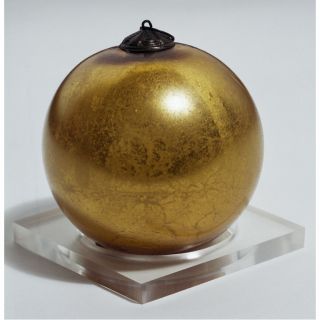
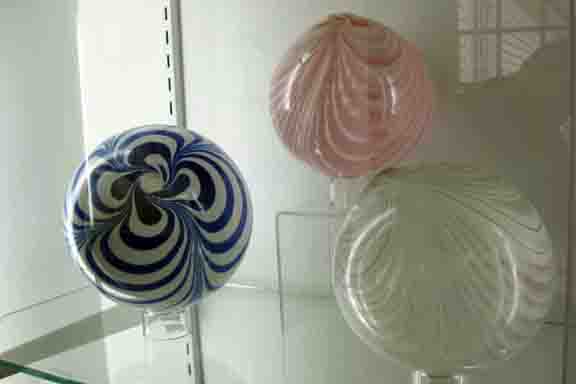
Witch Balls – Warding Off Evil Spirits

A witch ball is a hollow sphere of plain or stained glass hung in cottage windows in 18th century England to ward off evil spirits, witch’s spells or ill fortune”

Yesterday I did a post on Sulphide Marbles (Read: Sulphide Marbles or Figural Marbles) which got me thinking of all of the other round or cylindrical glass historical and antique objects that we collect including Lightning Rod Balls, Target Balls, Witch Balls, Christmas Ornaments, Paper Weights, Friendship Balls, Gazing Balls (read: Paperweight Collectors Association) and Glass Floats. Wow. I bet there are more.

I consider this aspect another important part of our historical glass collecting community where the common link is our love of glass. Elizabeth and I also collect Lightning Rod Balls and we adore the historical and architectural significance of these glass adornments on weather vanes. Our cactus and succulent gardens at Preach Ridge also have a few strategically placed glass Gazing Balls. Of course we all also remember…

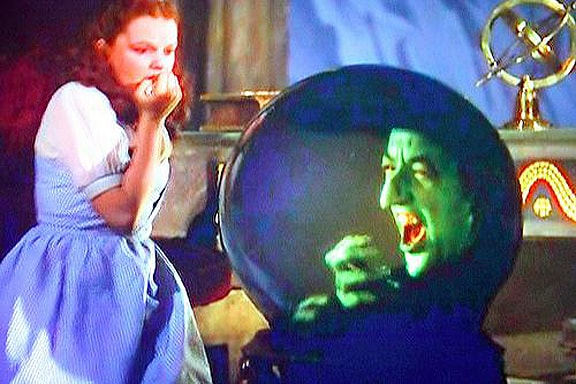
“I’ll get you my little pretty” 

I noticed that the latest Norman C. Heckler Auction had a Witch Ball in their current line-up so why not continue with a little about Witch Balls and a few pictures.

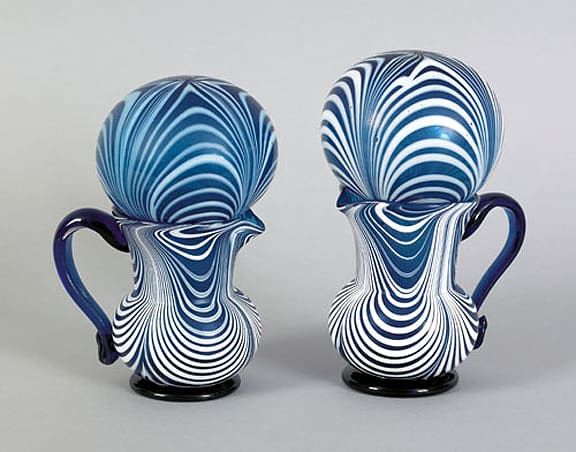
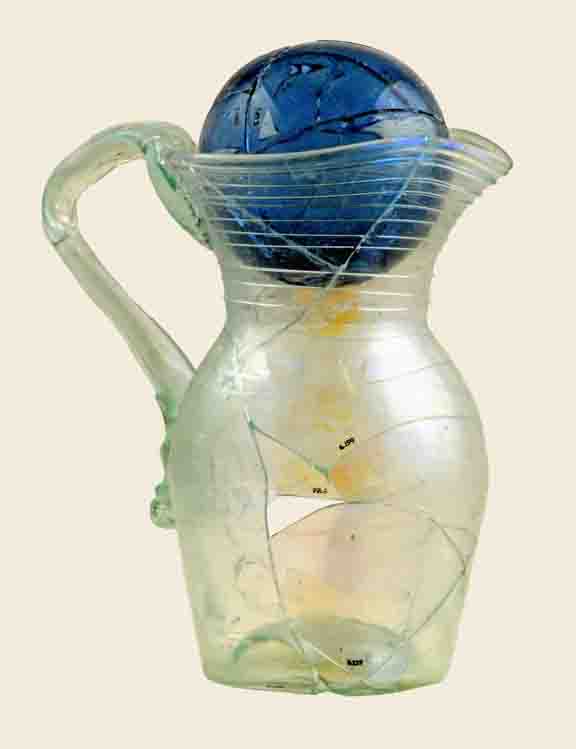
[from Wikipedia] A witch ball is a hollow sphere of plain or stained glass hung in cottage windows in 18th century England to ward off evil spirits, witch’s spells or ill fortune, though the Witch’s Ball actually originated among cultures where witches were considered a blessing and these witches would usually “enchant” the balls to enhance their potency against evils. Later, they were often posted on top of a vase or suspended by a cord (as from the mantelpiece or rafters) for a decorative effect. Witch balls appeared in America in the 19th century and are often found in gardens under the name gazing ball. However, gazing balls contain no strands within their interior.

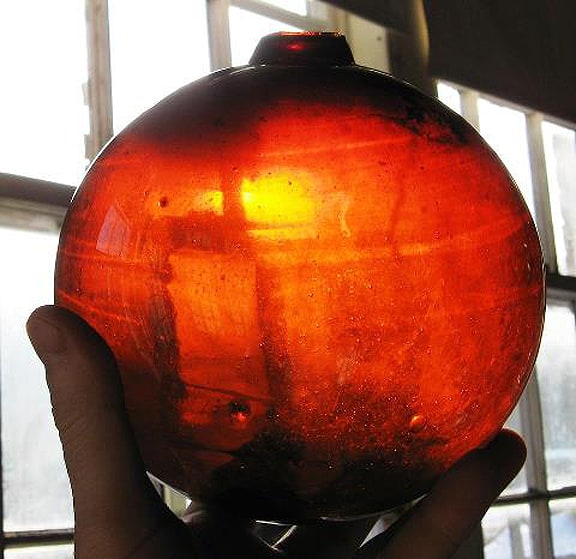
According to folk tales, witch balls would entice evil spirits with their bright colours; the strands inside the ball would then capture the spirit and prevent it from escaping. Witch balls sometimes measure as large as 7 inches (18 cm) in diameter. The witch ball is traditionally, but not always, green or blue in color and made from glass (others, however, are made of wood, grass, or twigs instead of glass). Some are decorated in enameled swirls and brilliant stripes of various colors. The gazing balls found in many of today’s gardens are derived from the silvered witch balls that acted as convex mirrors, warding off evil by reflecting it away.

Because they look similar to the glass balls used on fishing nets, witch balls are often associated with sea superstitions and legends. In the Ozark Mountains, a witch ball is made from black hair that is rolled with beeswax into a hard round pellet about the size of a marble and is used in curses. In Ozark folklore, a witch that wants to kill someone will take this hair ball and throw it at the intended victim; it is said that when someone in the Ozarks is killed by a witch’s curse, this witch ball is found near the body.

The word witch ball may be a corruption of watch ball because it was used as a guard of evil spirits. It is sometimes claimed that the modern Christmas ornament ball is descended from the witch ball. The ornament was allegedly originally placed on the tree to dispel a visitor’s envy at the presents left beneath the tree. However as the modern Christmas bauble’s origins are documented in Lauscha, Germany in 1847, the provenance of this claim is debatable.

“I’ll get you my little pretty” One of the most famous crystal balls in entertainment history sold for $110,000 plus buyer’s premium.

Pair of South Jersey pitchers and witch balls, ca. 1850, sold for $28,080. (Pook & Pook inc.)

Witch ball used to cap and seal a glass pitcher

Early Boston & Sandwich Witch Balls on display

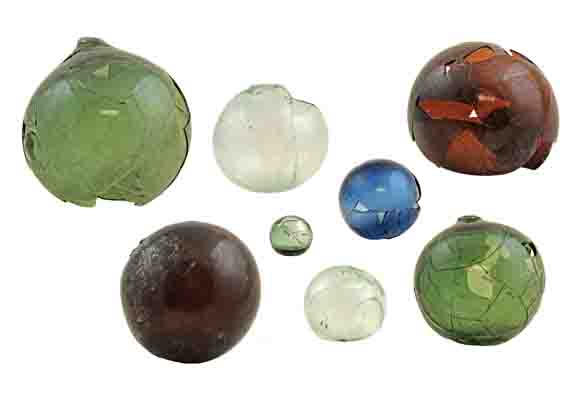
Reconstructed witch balls measuring 1.25” — 7” diameter; colors include green, aqua, amber, cobalt, and amethyst. Click for enlargement.

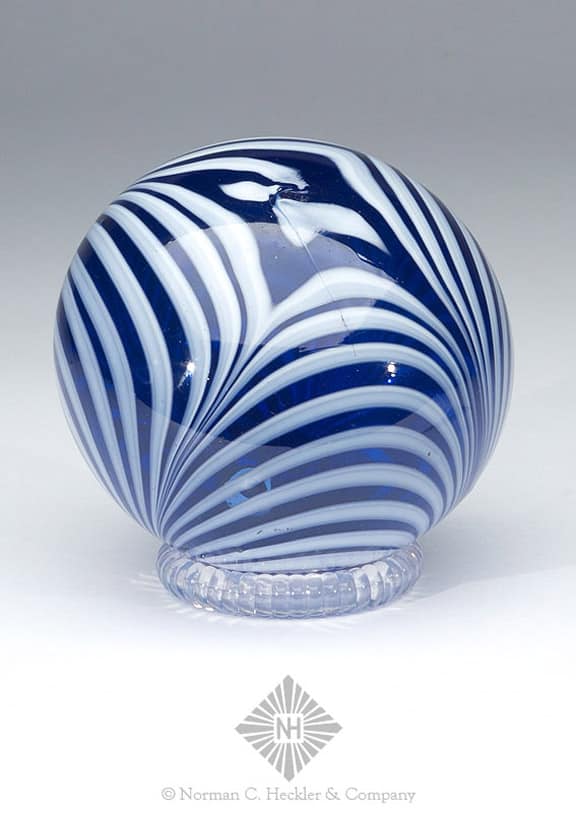
Fancy Freeblown Witch Ball, probably America, 1840-1870. Cobalt blue with white loopings, sheared mouth – smooth base, dia. 4 inches.

Witch Balls and Stands offered by Jeff and Holly Noordsy

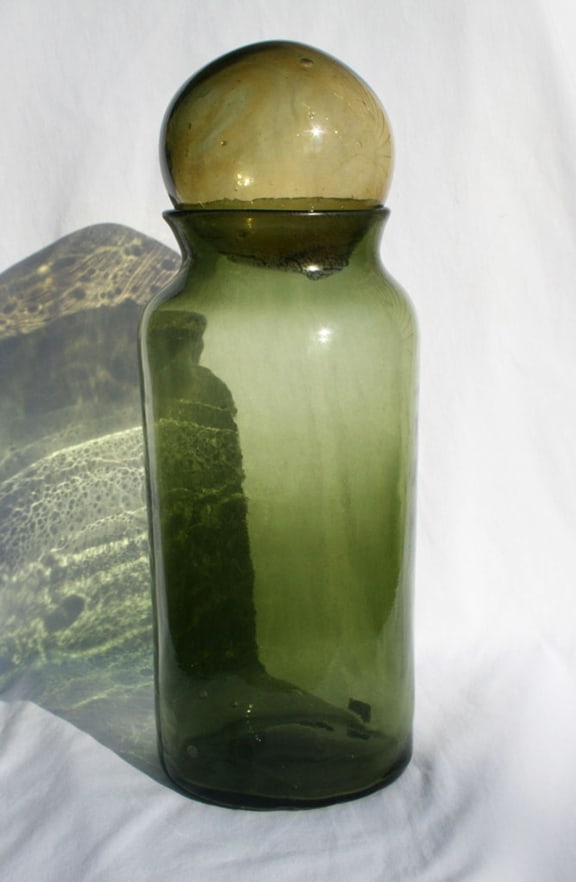
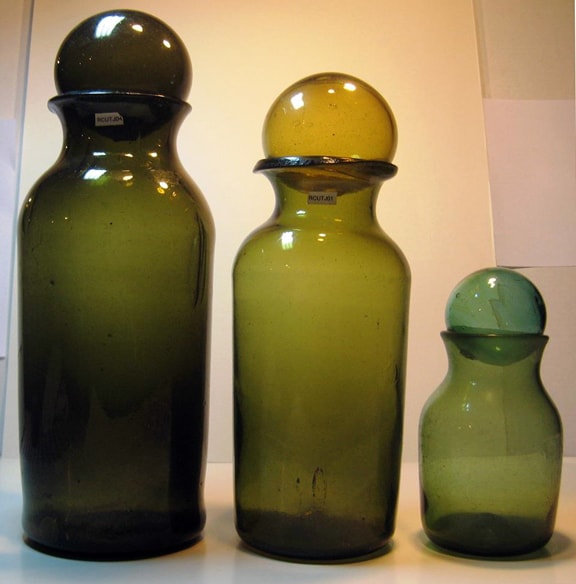
Huckleberry Food Jar with Witch Ball Circa 1860’s. Olive Green. Size: 11″ high x 5″ dia.

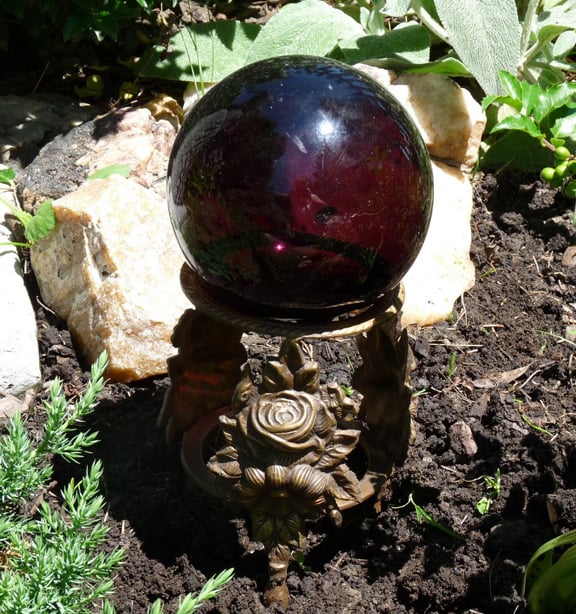
Unlike hanging friendship balls or witch balls that have a loop, gazing balls have a stem so they can securely sit in a stand. Larger sizes can be made, but may be difficult due to the weight of the blown glass.

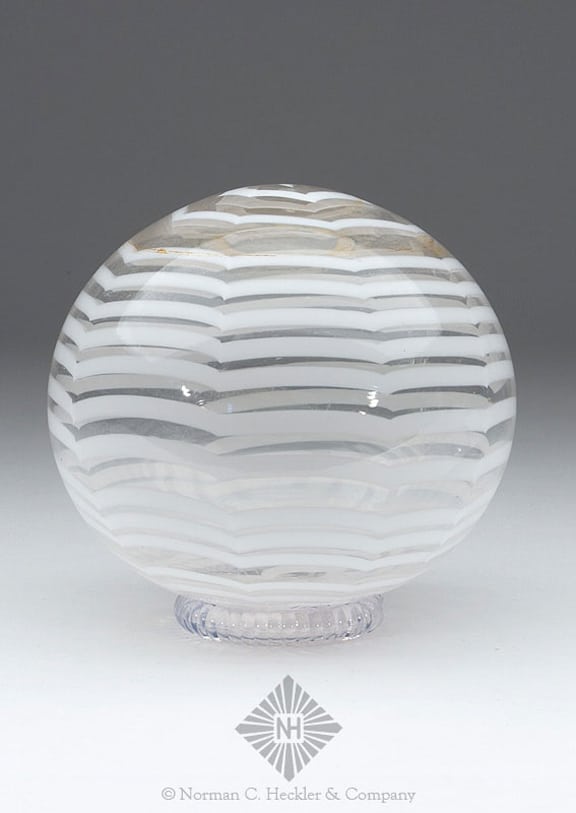
Nailsea Type Witch Ball, possibly America, 1840-1880. Colorless with an unusual pattern of irregular horizontal white stripes, sheared mouth – smooth base, dia. 5 inches. Rare decoration,

Witch Ball – Tony Lennon Collection

Three jars and three witch balls – Rick Ciralli

HecklerWitchBall017

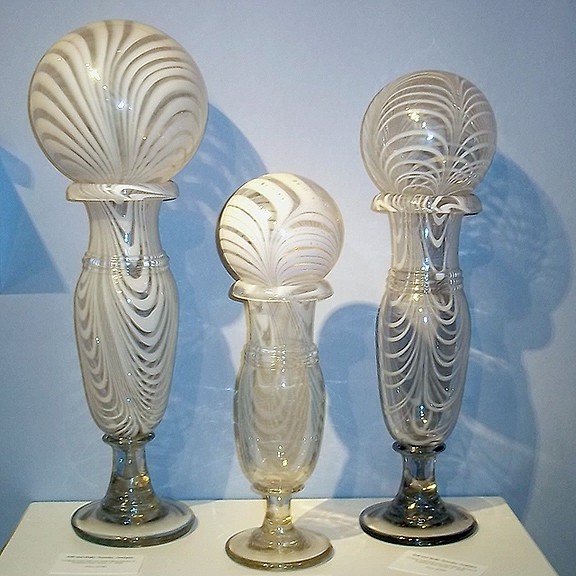
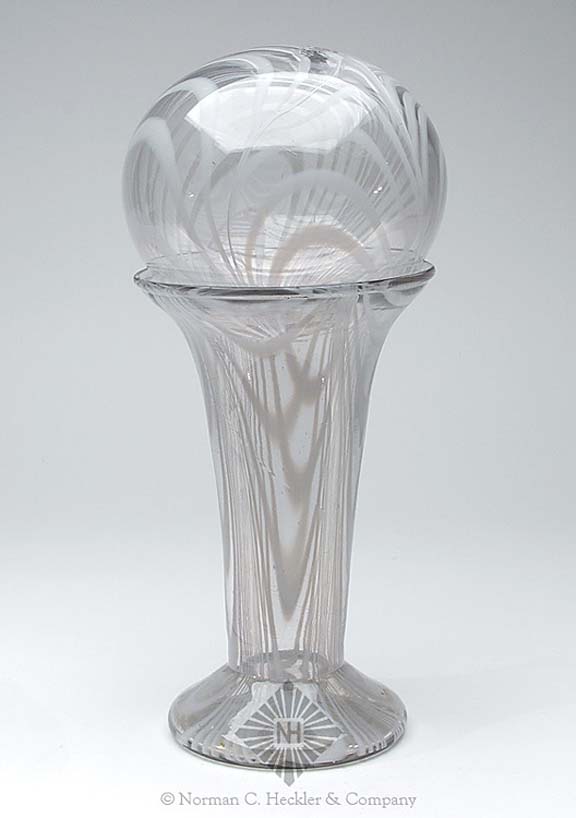
Freeblown Witch Ball And Stand, probably a South Jersey glasshouse, New Jersey, 1850-1860. A hollow ball on a trumpet form base, colorless with profuse white pulled loopings, sheared rim – pontil scar, overall ht. 11 3/8 inches. Fine early decorative freeblown American glass. – Heckler Auction 102

Posted in History, Witch Ball | Tagged , , , , , | Leave a comment

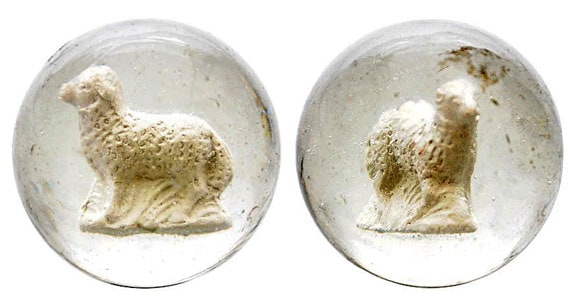
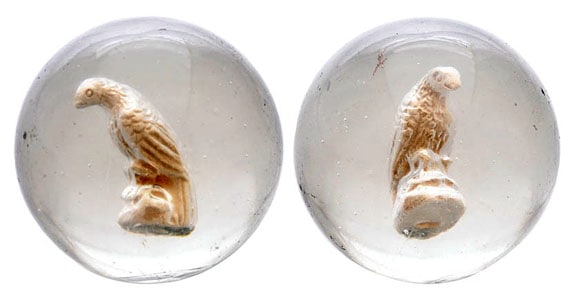
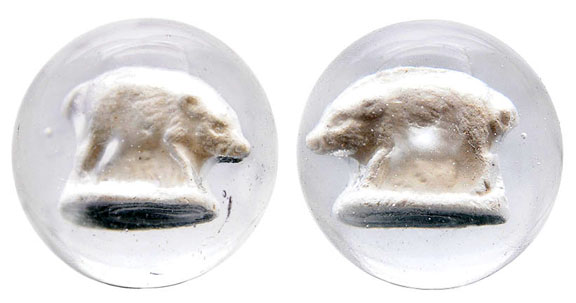
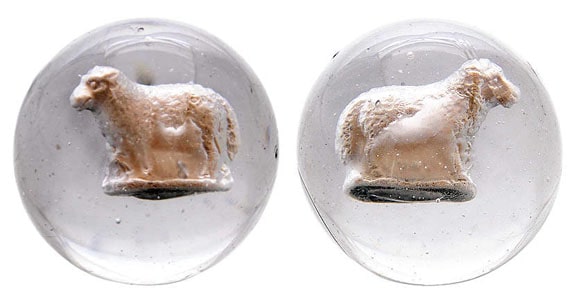
Sulphide Marbles or Figural Marbles

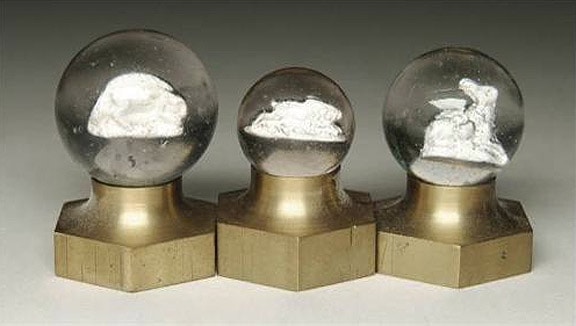
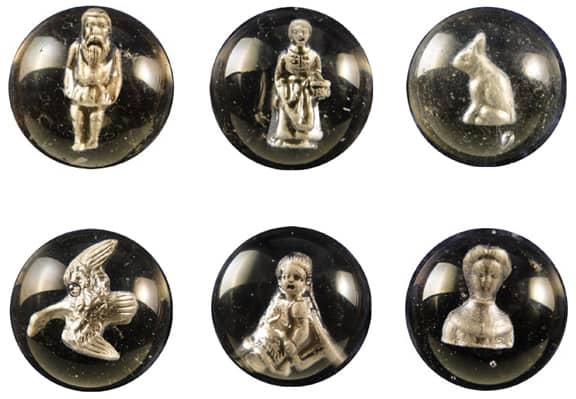
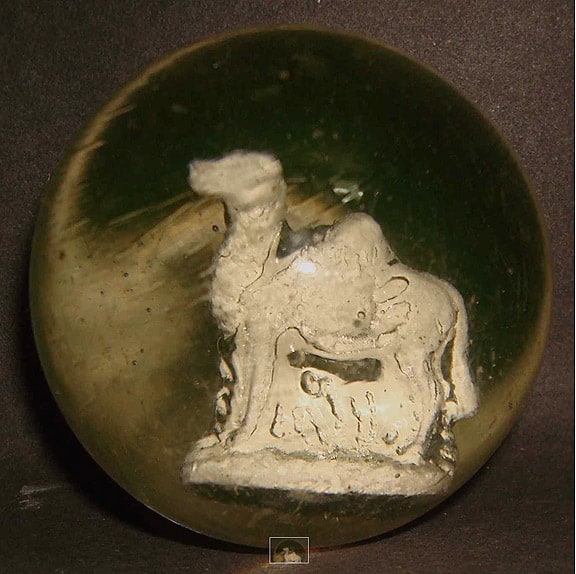
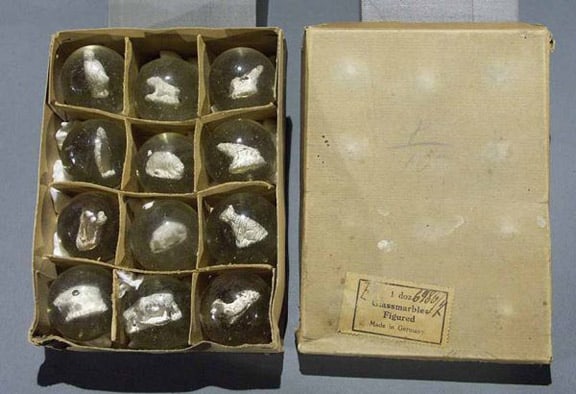
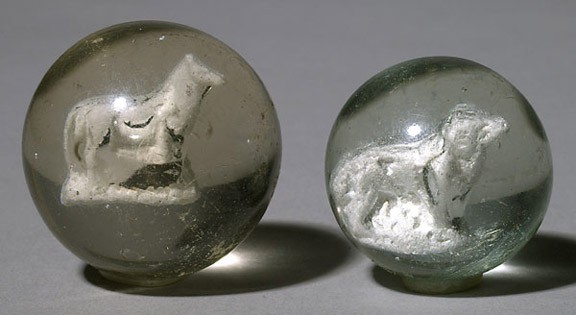
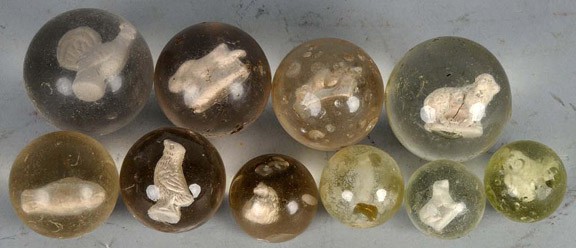
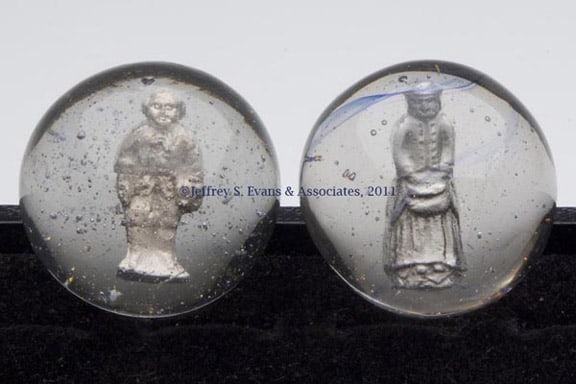
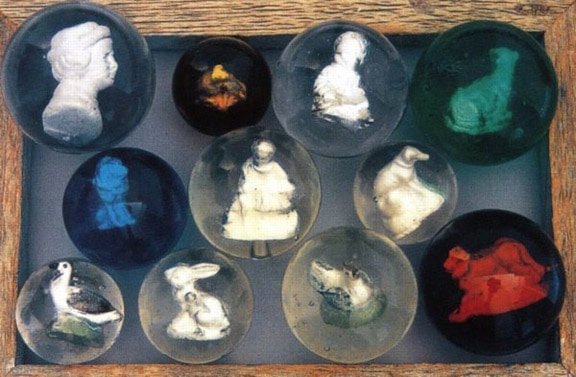
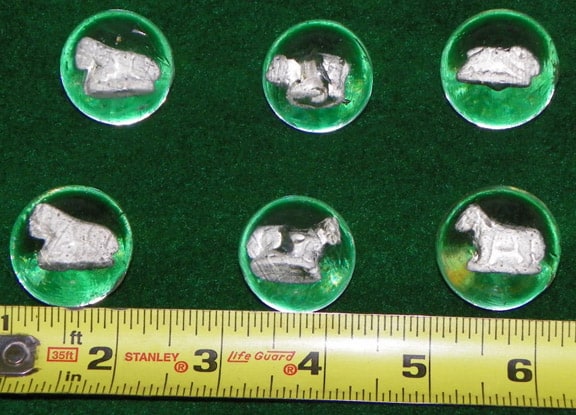
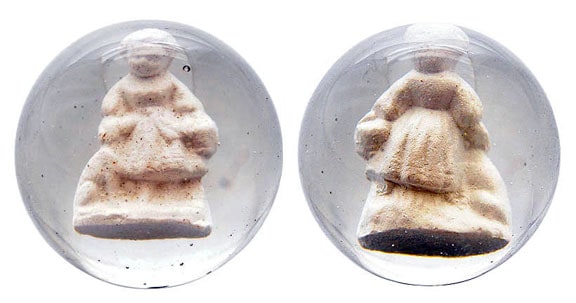
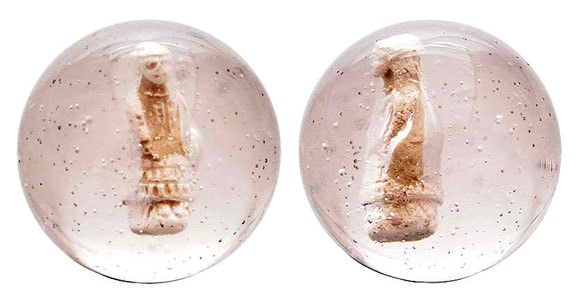
[from Marbles Galore] Sulphides, or figure marbles, are large translucent marbles manufactured in Germany from the mid-19th century up until the 1930s. Usually 1 1/2″ or more in size, they always feature a figure encased in the center, which early collectors mistakenly thought was made from sulfur. In fact these figures are made from porcelain and are usually animals but the rarer ones include people or numbers or other objects. No one knows exactly how many different figures or objects were made, but hundreds are known to exist.

I noticed that the latest Glass Works ‘Ides of March’ Auction had a number of marble lots, many of them Sulfides. I’ve always liked these figural marbles and if I started collecting marbles I might start here. I put together some pictures of these neat collectibles.

If you are ever at Jeff Wichmann’s American Bottle Auctions in Sacramento, ask to look at some of Jeff’s great marbles. He really gets fired up telling you about all the variations and colors. He also has many of them displayed in a custon table stand that Richard Siri built.

Read further: Marbles Galore | Marble Auction House: Morphy Auctions | Nice Article on Jeff Wichmann at Mad Marbles | A Brief History of the Birth of the Modern American Toy Industry in Akron, Ohio | Marble Books | Marble Forum

Posted in Marbles | Tagged , , , , , , , , , | Leave a comment

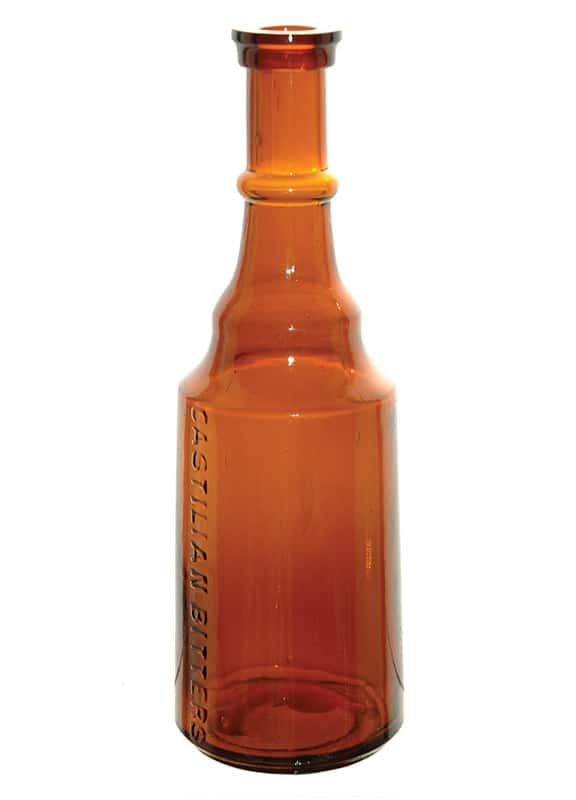
Castilian Bitters – Brown & Embree Proprietors – New York

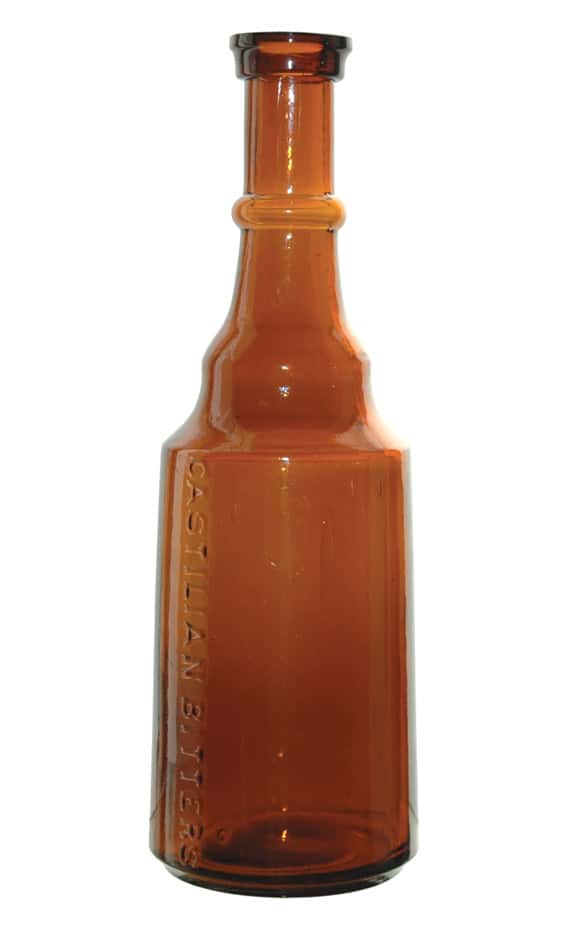
Castilian Bitters – Brown & Embree Proprietors – New York

18 March 2012

Apple-Touch-IconAThis is a follow-up post dedicated to the Castilian Bitters that was referenced in the previous Brown’s Castilian post (read: Brown’s Castilian Bitters – Transitional Cannon Barrel Figural)

‘Patent Elixir to which our ancestors were indebted for their vigorous health”

Castilian in this instance is most likely Spanish (Spanish: español) and is a romance language named for its origins as the native tongue of a large proportion of the inhabitants of Spain. Castilian (Spanish: castellano) after the Spanish region of Castile where it originated.

In Bitters Bottles by Carlyn Ring and W.C. Ham, they describe the form as ‘Bell’ shaped. I am not sure about this and personally group this bottle and my similar shaped bottles in one window row and call them transitional cannon (barrels).

Other bitters collectors refer to them as ‘lighthouses’ which I do not see. Finding a labeled example or advertising to support the bottle makers intent is important.

Look at the neat A.M. Bininger & Co. cannon that is on display at the Corning Museum of Glass (read: A. M. Bininger & Co. Figural Cannon). No doubt this bottle is a cannon barrel.

C 80  CASTILIAN BITTERS, Circa 1865 – 1875
CASTILIAN BITTERS // c //
Brown & Embree Proprietors, Office & General Depot at Sackett & Belcher Co.,
28 & 30 Reade St., New York
10 x 3 (5 1/4)
Bell, Amber, NSC, Applied mouth, Scarce
Label: Prepared…pure juice of Isabella grapes. Combination of Extracts distilled from the products of the south of France and Italy and the Province of Castile (Old Spain) from which latter section they derive their name the Patent Elixir to which our ancestors were indebted for their vigorous health and manly stamina a fragrant females and children for all their disarrangements of the stomach it is unrivaled a certain cure for fever, ague, dyspepsia, flatulency and etc. – a never failing preventative and cure for seasickness – one who travel by land or water should not be without the Castilian Bitters.

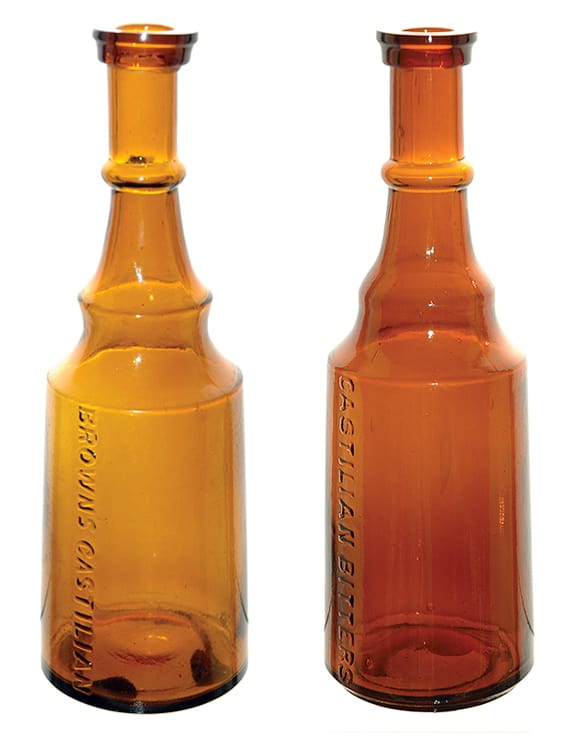
BROWNS CASTILIAN Bitters and a CASTILIAN BITTERS – Meyer Collection

C 80 CASTILIAN BITTERS – Meter Collection

(L-R) WARSAW BITTERS, BROWN’S CASTILIAN, SOL FRANK’S PANACEA BITTERS, CASTILIAN BITTERS and a GLOBE BITTERS – Meyer Collection

Posted in Bitters, Collectors & Collections, Figural Bottles | Tagged , , , , , , , | Leave a comment

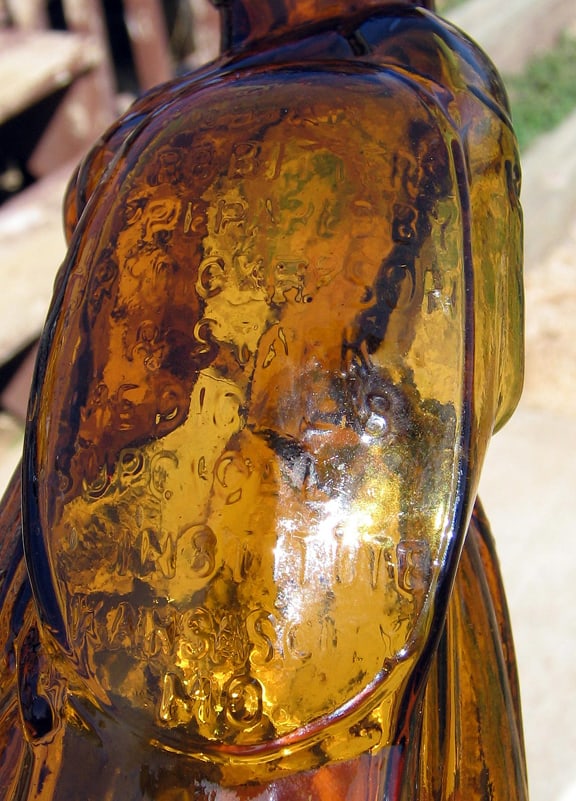
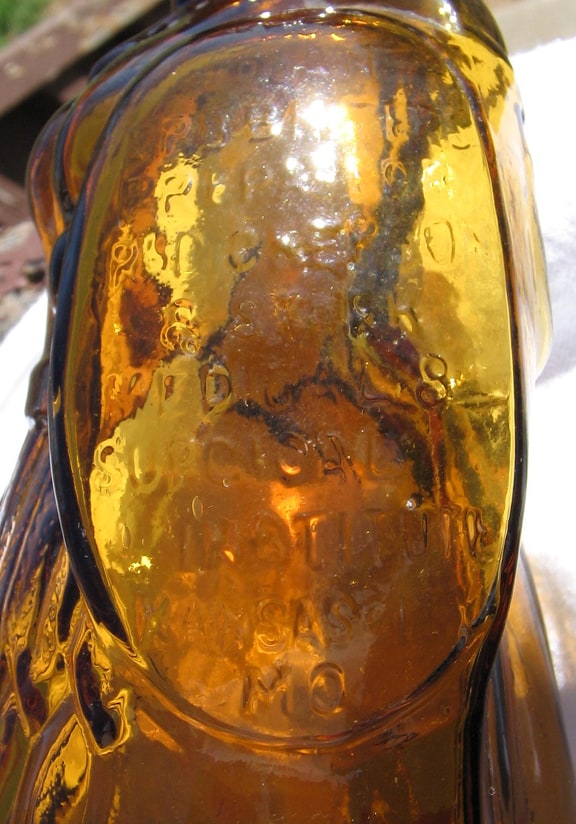
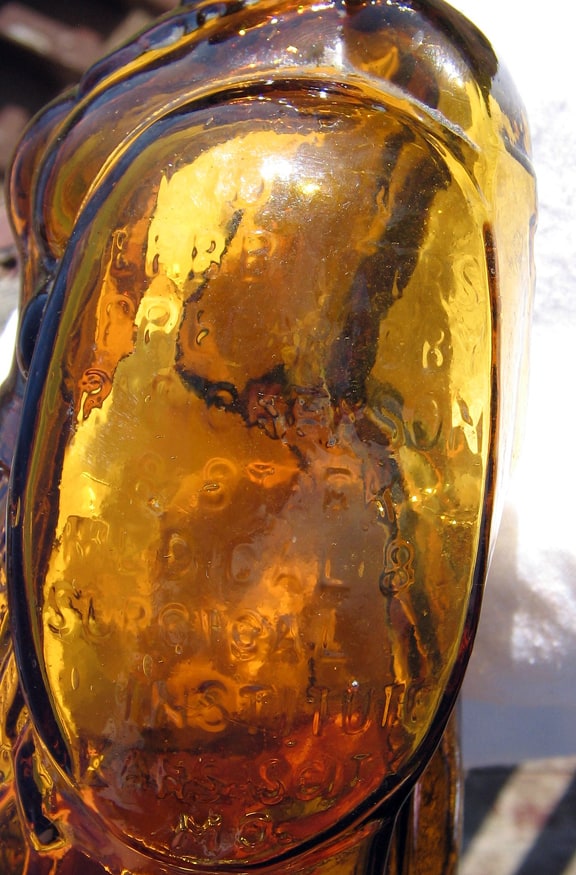
Ladies & Gents…The Kansas City Queen

"With shocking disbelief I share pictures of the legendary INDIAN HERB BITTERS – Prepared by Drs Dickerson & Stark Medical & Surgical Institute Kansas City, Missouri that walked in the door of the St. Joseph, Missouri Bottle & Insulator Show this past weekend.

Ladies & Gents…The Kansas City Queen

16 March 2012

Apple-Touch-IconAI have a top 10 want list that I suppose others of you have also. Let me tell you. This wasn’t even on it because I doubted one existed. I had always heard rumors of one existing in a museum somewhere but my questions over the years have resulted in no confirmation. I am now hearing one exists in an Iowa museum that I will track along with the new find. I am going to hold back on the rest of the story because I have been asked to.  I quite honestly am disappointed that this is not mine after an effort of some magnitude. Obviously not enough though.

Kudos to the buyer and thus quick seller. Someone has a great bottle.

I-18  THE INDIAN HERB BITTERS

THE / INDIAN / HERB BITTERS / PREPARED BY / DRS DICKERSON / & STARK / MEDICAL & / SURGICAL / INSTITUTE / KANSAS CITY / MO // SEND FOR OUR ILLUSTRATED MEDIAL JOURNAL / IT WILL BE SENT FREE TO ANY ADDRESS //
12 3/8 x 3
Figure of Indiand queen, Amber, SCM, Extremely rare
Kansas City Directory 1886; John Stark and D’Estaing Dickerson, 427 Delaware Ave.

Posted in Bitters, Bottle Shows, Digging and Finding, Figural Bottles, News | Tagged , , , , , | 2 Comments

Doyles Hop Bitters and some Exciting Variants

“For general debility, biliousness, nervousness, neuralgia, indigestion, fever and ague, liver complaint, mental depression and all kidney and urinary diseases. Compounded from hops, buchu, mandrake, dandelion, etc. Under the best medical ability existing”.

Doyles Hop Bitters and some Exciting Variants

15 March 2012 (R•010514)

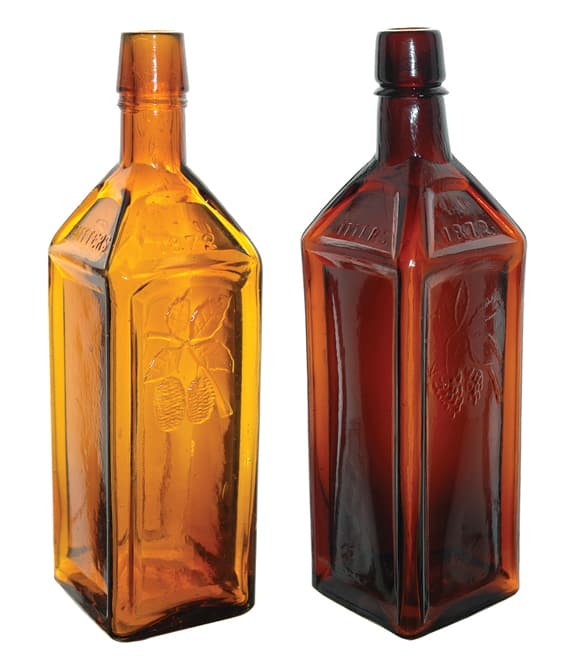
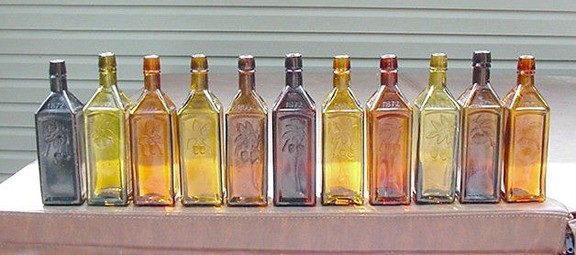
Apple-Touch-IconAThere has been some exciting information posted over at the Bottle Collectors facebook page on the D 93 and D 94 Doyle’s Hop Bitters by Brian Shultis. Brian is from Crossville, Tennessee and specializes in Drakes Plantation Bitters and semi-cabin forms. Brian first started by posting a killer picture of a color run (see below) that he had assembled in years past. Brian noted “they are long gone! Sold and traded most, to pursue my Drake’s!”

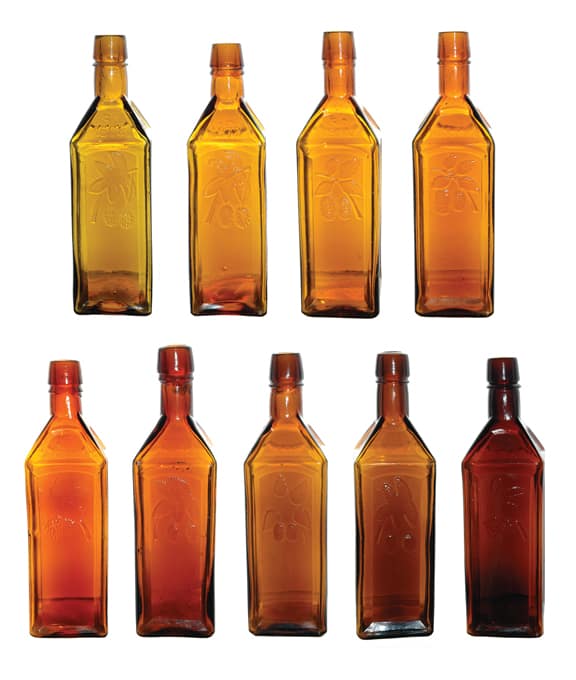
One of my first runs in my collecting. Doyle’s Hop Bitters. Although common except for a few mold variants. I still think they are great looking semi cabins! – photo and comment Brian Shultis

I know I now own one (1) of those Shultis bottles from his color run that I purchased from Brian on eBay back in 2003. I also have a color run and have been assembling the different Hop and Berry motifs for each color which is challenging (see picture below). Brian notes that there are twenty different Hops and Berry motifs!

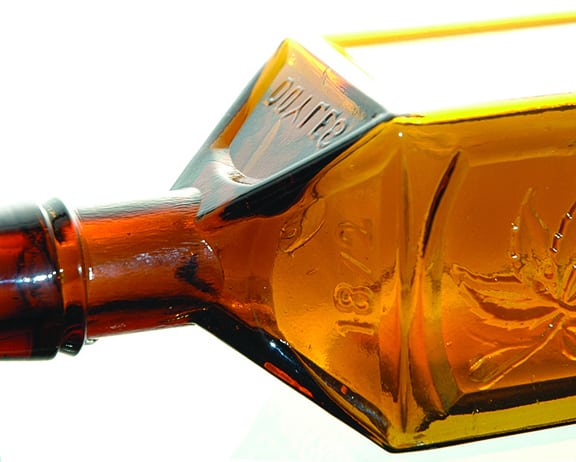
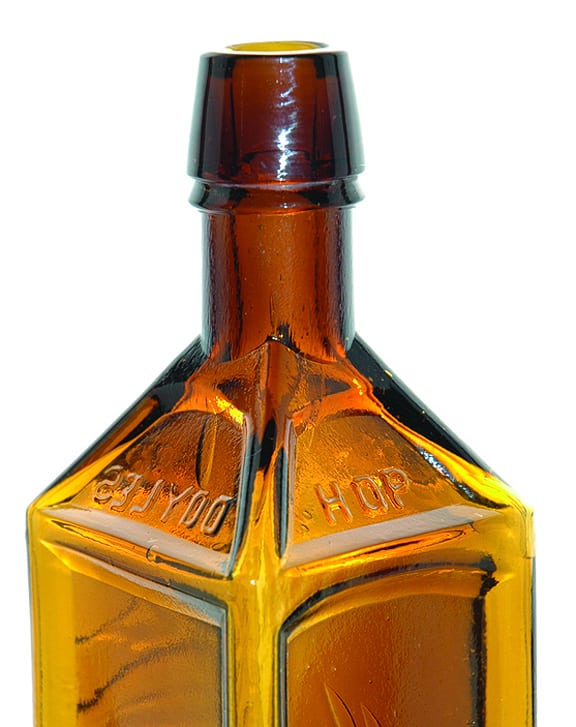
There is also a D 94.5 XR variant that has the DOYLES backwards that I have pictured below. Brian also states that there is a variant that has “DOYLE’S” backwards on all 4 roof panels. That is a variant he saw on eBay. It is XR also!

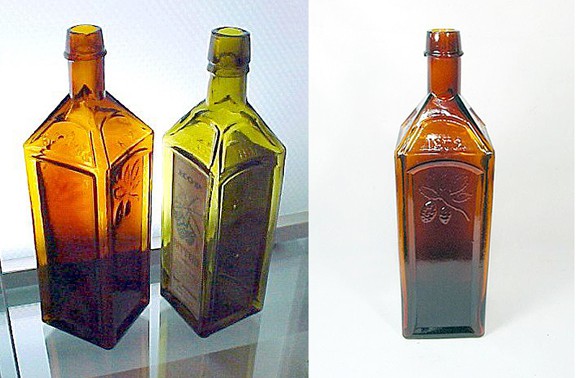
The D 94 DOYLE’S HOP BITTERS with the curved BITTERS embossing really surprised me as I was not aware of this mold. According to Brian, this variant is larger and has the unusual lip treatment much like the Niagara Star Bitters. This variant is often referred to as a Niagara Star mold by some collectors (see pictures below).

D 93  DOYLES HOP BITTERS, Circa 1872 – 1875
// s // DOYLES // HOP // BITTERS // 1872 //
sp // sp // sp // motif hop berries with leaves //
Hop Bitters Manufacturing Co. Rochester, N.Y. Toronto, Ont. London, England
9 5/8 x 2 3/4 (6 1/4)
Square, DLTC, Applied mouth and Tooled lip, 4 sp, Amber – Common; Yellow and Yellow olive – Rare

Panels under HOP and 1872 curved at top, others are straight. A variant of this bottle which only has the hop berries embossed on one panel but has no shoulder embossing has been recorded. One of the most popular bitters. Available in a wide variety of shades of amber, hop motif design and lettering size, but variations are minor considering the great number in circulation.

Label: For general debility, biliousness, nervousness, neuralgia, indigestion, fever and ague, liver complaint, mental depression and all kidney and urinary diseases. Compounded from hops, buchu, mandrake, dandelion, etc. Under the best medical ability existing. Dosage in English and German.

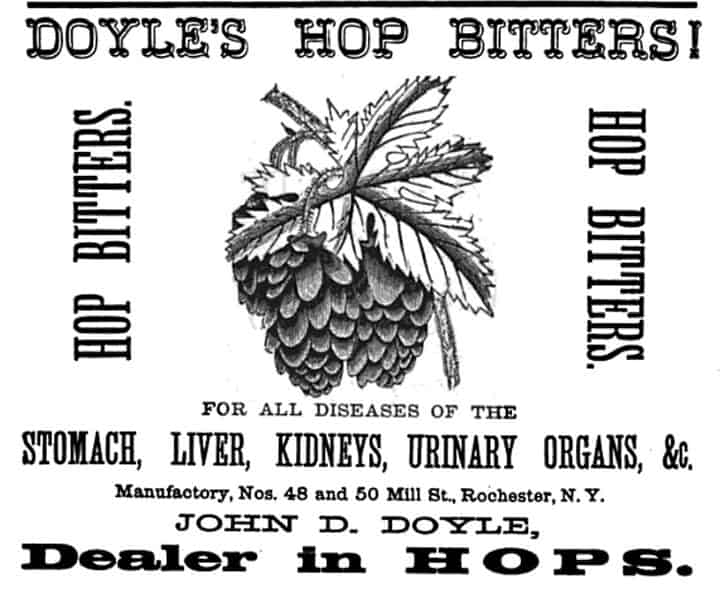
Note: J. D. Doyle of Rochester, N.Y. patented this brand in 1872 and that same year he gave sole proprietorship to Asa T. Soule, a Quaker and long-time patent medicine salesman. Soule devoted all his energies and money to immediately promoting the brand and evidently bought ownership from Doyle the following year or became the primary owner of the Hop Bitters Manufacturing Co., with Doyle receiving a small royalty. Asa was somewhat of an eccentric in many ways including the way he advertised their medicines and perhaps that’s what made him a fortune by the 1880’s. He spent huge sums promoting real estate in Kansas but lost money in most of his ventures there. When H. H. Warner, out of Rochester began making inroads into his medicine business. Soule returned and went on to very successful.

DoylesHopBitters_Roch_CD1873

Doyle’s Hop Bitters put out by John D. Doyle, Dealer in Hops – 1873 Rochester City Directory

(left and right) Amber Doyle’s Hop Bitters (D 94 variant) with the curved BITTERS embossing This variant is larger and has the unusal lip treatment much like the Niagara Star Bitters. This variant is often reffered to as a Niagara Star mold by some collectors. The center bottle is the common D 93 in a not so common coloration. Photos and information by Brian Shultis

D 93 DOYLE’S HOP BITTERS pair. Notice the different Hop embossings – Meyer Collection

DOYLE’S HOP BITTERS – Meyer Collection

D 94.5  DOYLES (backwards) HOP BITTERS // s // DOYLE’S (backwards) // HOP // BITTERS // 1872 //
sp // sp // sp // motif hop berries with leaves
9 5/8 x 2 3/4 (6 1/4)
Square, Amber, DLTC, 4 sp, Extremely rare

D 94.5 DOYLE’S (backwards) HOP BITTERS (extremely rare) – Meyer Collection

D 94.5 DOYLE’S (backwards) HOP BITTERS (extremely rare) – Meyer Collection

Posted in Advertising, Bitters, Collectors & Collections, Color Runs, Figural Bottles, History | Tagged , , , , , , , | Leave a comment

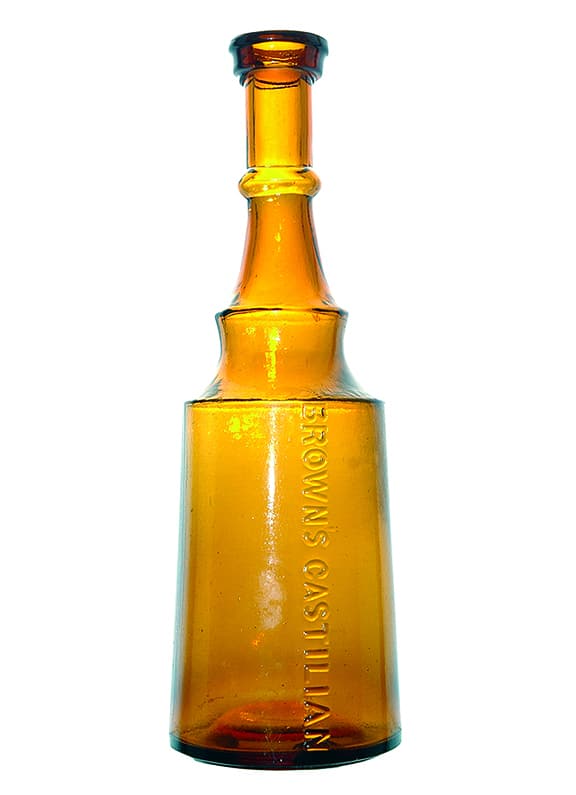
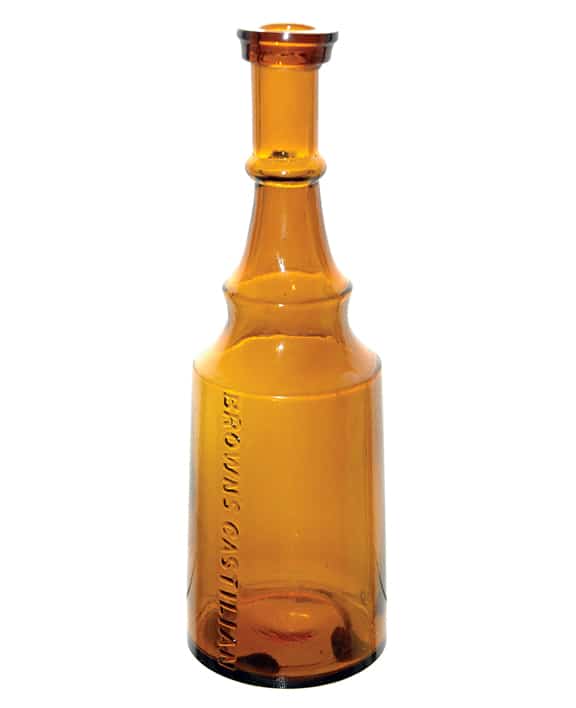
Brown’s Castilian Bitters – Transitional Cannon Barrel Figural

Brown’s Castilian Bitters – Transitional Cannon Barrel Figural

14 March 2012

The Carlyn Ring and W.C. Ham listing in Bitters Bottles is as follows:

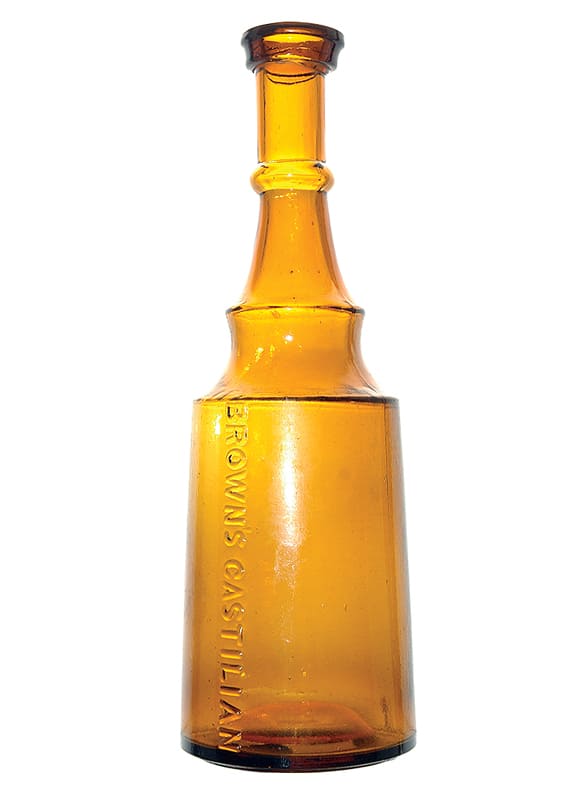
B 221.6  BROWN’S CASTILIAN BITTERS
BROWN’S CASTILIAN // c //
Wm. H. & Jerome B. Brown, Baltimore, Maryland
11 1/4 x 3 1/2 (5 1/4)
Bell-shaped, Amber, LTC Similar in shape of Globe Bitters (New York)

Apple-Touch-IconAFirst, let us look at the definition of Castilian which is noted as meaning Cannon in some Bitters books. I can not find anything to support this. Castilian is most likely Spanish (Spanish: español) and is a Romance language named for its origins as the native tongue of a large proportion of the inhabitants of Spain. Castilian (Spanish: castellano) after the Spanish region of Castile where it originated.

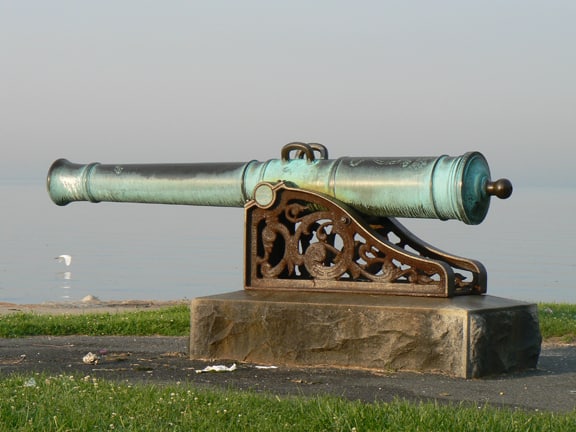
A cannon captured from a Spanish warship has been mounted in Bridgeport’s (CT) Seaside Park to honor the service of local residents during the Spanish-American War.

Some Bitters collectors like myself, do consider this to be a transitional cannon barrel figural Bitters (to coin the efficient ‘transitional’ descriptive term used by Bitters collector Jeff Burkhardt, who feels that this bottle may be a transitional lighthouse shape. If you look at the cannon barrels in the two (2) pictures above, you will see ‘rings’ on the barrels similar to the subject bottle. This leads me to think cannon rather than lighthouse. As Jeff notes in his comment at the bottom of the page, we need to find labeled examples and more advertising.

Previous cannon figural posts are more exacting in the cannon barrel shape such as the A.M. BININGER, J.T. GAYEN and the R & G. A. WRIGHT. In this next segment in the Figural Cannon Series there will be new posts including the Globe Bitters, Warsaw Stomach Bitters, Castilian Bitters and Sol Franks Panacea Bitters, all with similar bottle forms. Interesting enough, Ring and Ham uses “bell shaped” for the Brown’s Castilian Bitters description, “lighthouse form” for the Sol Franks Panacea Bitters and references a Cannon on the Castilian Bitters. Who knows…when I look at my grouping positioned on a shelf in a window, I call them cannon figurals. I do see the lighthouse form in the Sol Franks though.

The Brown’s names is very interesting on this bottle. It is conjecture that the Brown’s Castilian is a Bitters and that it is a Baltimore bottle. There is however the Wm. H. & Jerome B. Brown, Baltimore, Maryland note in Carlyn Ring and W.C. Ham Bitters Bottle book. When searching Baltimore archives on-line, I can not find any supporting information confirming that this is a Baltimore bottle.

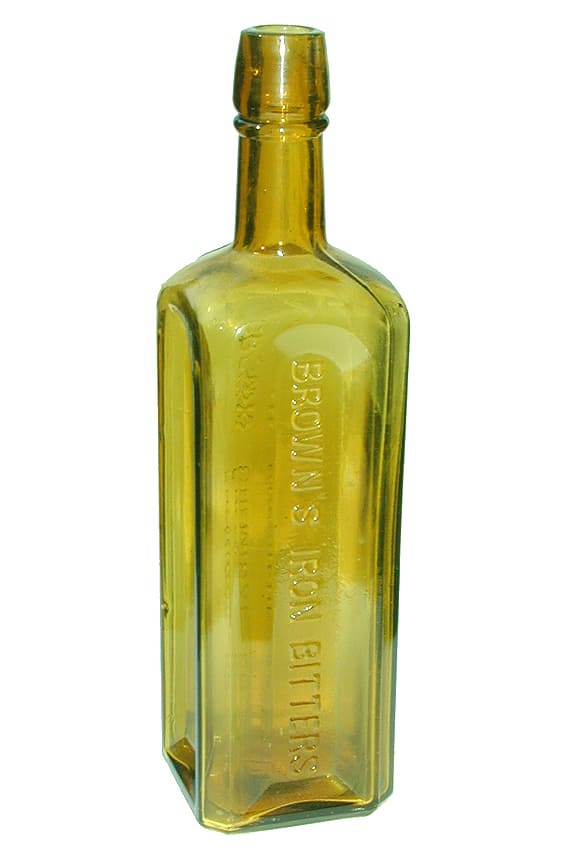
There is also a rather well know Brown’s Iron Bitters (Brown Chemical Company) from Baltimore (pictured below) that confuses the issue. I can not imagine Brown Chemical Company making the Brown’s Castilian Bitters. Of course there are other prominent names for Brown in the Bitters world such as the Brown & Lyon Bitters, Brown’s Aromatic Bitters, Brown’s Herb Bitters and the Brown’s Celebrated Indian Herb Bitters (Indian Queen) to name a few that reside in my collection.

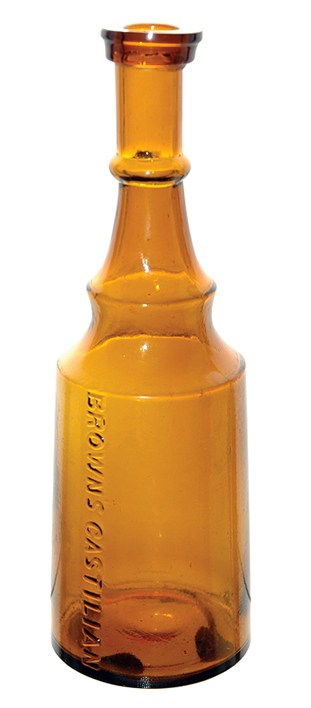
Where it gets confusing to me, is that there is an exact shape Bitters called the Castilian Bitters (pictured below) with a note for Brown & Embree Proprietors, Office & General Depot at Sackett & Belcher Co., 28 & 30 Reade St., New York with a label reading…Prepared…pure juice of Isabella grapes. Combination of Extracts distilled from the products of the south of France and Italy and the Province of Castile (Old Spain) from which latter section they derive their name the Patent Elixir to which our ancestors were indebted for their vigorous health and manly stamina a fragrant females and children for all their disarrangements of the stomach it is unrivaled a certain cure for fever, ague, dyspepsia, flatulency and etc. – a never failing preventative and cure for seasickness – one who travel by land or water should not be without the Castilian Bitters. The Globe Bitters, also a similar shape as noted in Ring & Ham is also a New York bottle. I have pictured both the BROWN’S CASTILIAN Bitters and the CASTILIAN BITTERS side by side. They are both 11 1/4″ tall. Looks like the same mold, typography and applied tops!

BROWNS CASTILIAN Bitters and a CASTILIAN BITTERS – Meyer Collection

B 231 BROWNS IRON BITTERS (Brown Chemical Company) – Meyer Collection

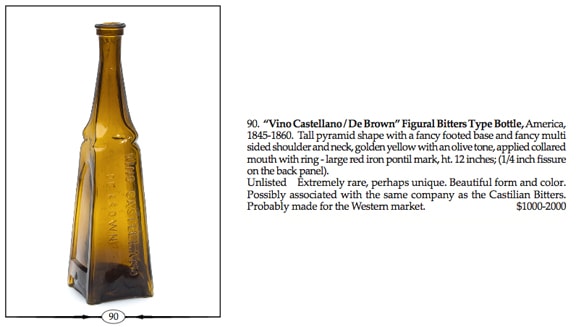
Another tantalizing bit of information showed up in the Norman C. Heckler Auction 92 in May 2011. This was for the surprising similar, and possibly unique VINO CASTELLANO / DE BROWN (pictured below). Heckler states ” Possibly associated with the same company as the Castilian Bitters” and also notes “Probably made for the Western Market”. Not sure where this Western part comes from but there are present day vineyards that are named Vino Castellano in Auburn, California.

“Possibly associated with the same company as the Castilian Bitters”

BROWN’S CASTILIAN Bitters – Meyer Collection

BROWN’S CASTILIAN Bitters – Meyer Collection

BROWN’S CASTILIAN Bitters – Meyer Collection

(L-R) WARSAW BITTERS, BROWN’S CASTILIAN, SOL FRANK’S PANACEA BITTERS, CASTILIAN BITTERS and a GLOBE BITTERS – Meyer Collection


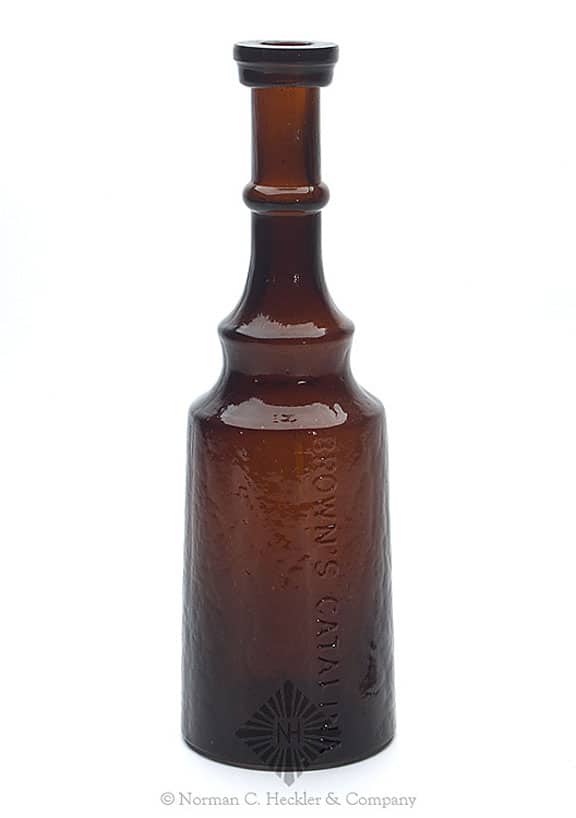
BROWN’S CATALINA

BrownsCatalina015

“Brown’s Catalina” Figural Medicine Or Bitters Bottle, probably a Stoddard glasshouse, Stoddard, New Hampshire, 1860-1872. Cylindrical, modified lighthouse form, olive amber, heavy applied square collared mouth – smooth base, ht. 10 7/8 inches. See R/H pg. 120 Beautiful, crude whittled bottle. Kris Kernozicky collection. – Heckler Auction #103

Posted in Bitters, Collectors & Collections, Figural Bottles | Tagged , , , , , , , , , , , , , , , , , , | 2 Comments

General Scotts Artillery Bitters – The Ultimate Cannon Barrel Figural

General Scotts Artillery Bitters – The Ultimate Cannon Barrel Figural

13 March 2012 (R•052814) (R•062517) (R•052719-Genius)
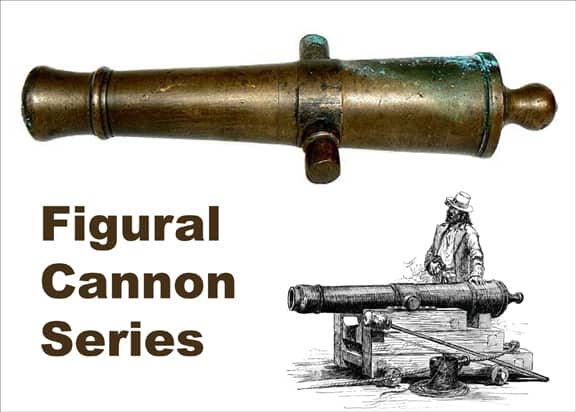
Apple-Touch-IconAThe next figural cannon, and in my opinion, the greatest example in rarity is the General Scotts Artillery Bitters. As recorded in Carlyn Ring and W. C. Ham in Bitters Bottles:

S78 GENL SCOTTS ( au ) / NEW YORK / ARTILLERY / BITTERS // c //
12 3/8 x 2 1/2 (10)
Cannon, Amber, SM, Ground lip, Extremely rare

Field rack of Civil War Cannons – photo Craig Swain (Leesburg, Virginia)

First a little background on General Winfield Scott from Wikipedia.
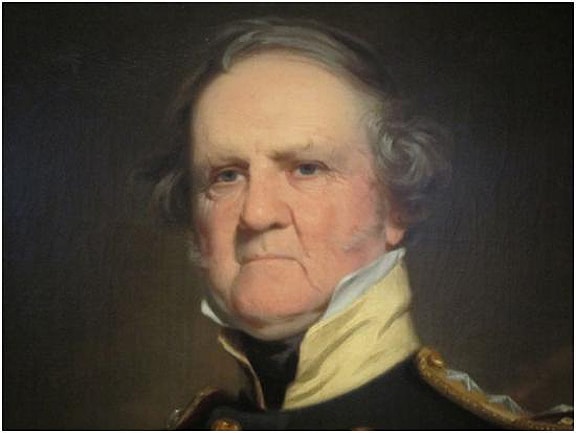
Major General Winfield Scott (1786-1866)

Winfield Scott (June 13, 1786 – May 29, 1866) was a United States Army general, and unsuccessful presidential candidate of the Whig Party in 1852.

Known as “Old Fuss and Feathers” and the “Grand Old Man of the Army,” he served on active duty as a general longer than any other man in American history and many historians rate him the best American commander of his time. Over the course of his forty-seven-year career, he commanded forces in the War of 1812, the Mexican-American War, the Black Hawk War, the Second Seminole War, and, briefly, the American Civil War, conceiving the Union strategy known as the Anaconda Plan that would be used to defeat the Confederacy. He served as Commanding General of the United States Army for twenty years, longer than any other holder of the office.

A national hero after the Mexican-American War, he served as military governor of Mexico City. Such was his stature that, in 1852, the United States Whig Party passed over its own incumbent President of the United States, Millard Fillmore, to nominate Scott in the United States presidential election. Scott lost to Democrat Franklin Pierce in the general election, but remained a popular national figure, receiving a brevet promotion in 1856 to the rank of lieutenant general, becoming the first American since George Washington to hold that rank.


Perfect Example

I believe that there are at least four (4) examples of the General Scotts Artillery Bitters out in collections with the signature example residing in the Sandor P. Fuss collection in Denver, Colorado.

This example is perfect and is ex: Charles Gardner, Robert Skinner, Jim Hagenbuch and Don Keating. The exact bottle is pictured in numerous books including American Bottles & Flasks by McKearin and Wilson and Bitters Bottles by Carlyn Ring and W.C. Ham. It is also the same bottle in the famous Carlyn Ring Collection: First Offering Sale in 1995 conducted by Jim Hagenbuch of Glass Works.
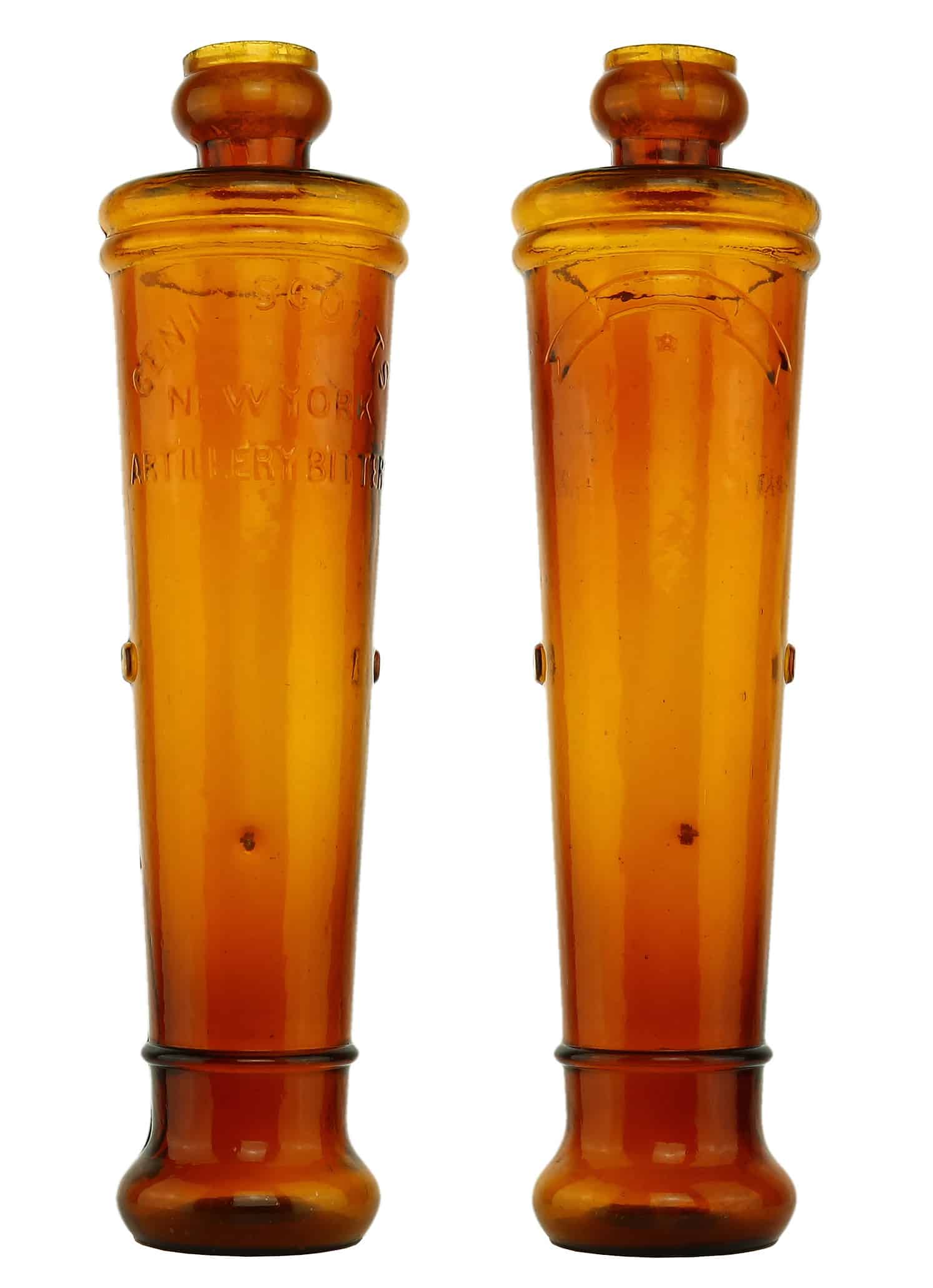
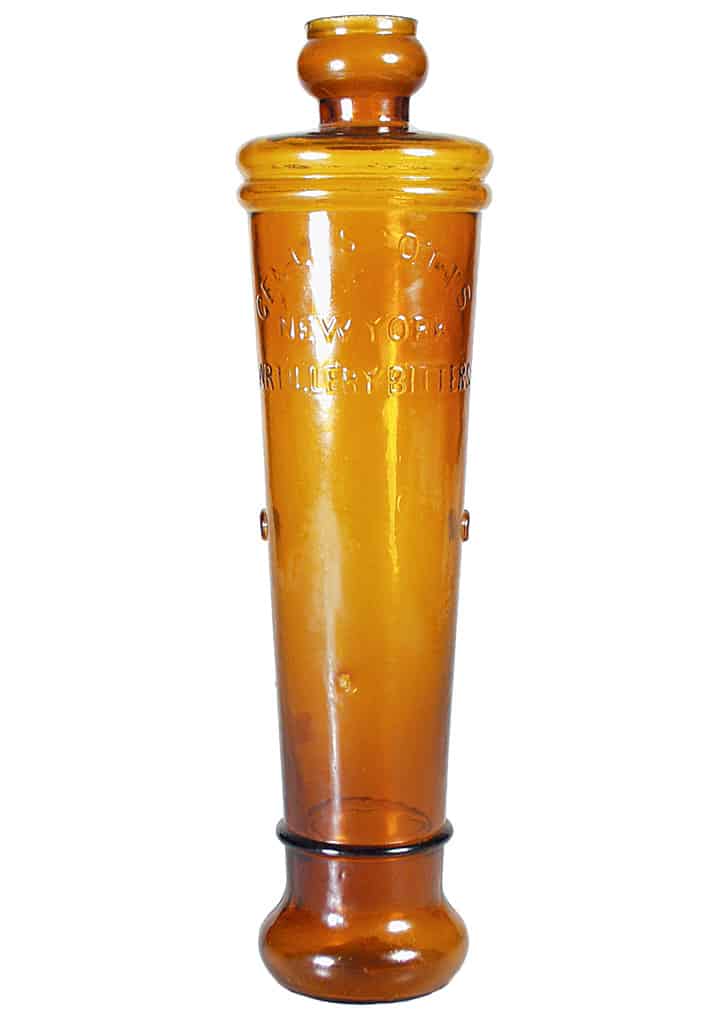
General Scott’s Artillery Bitters – New York – Sandor P. Fuss Collection
S78_ScottsCannon_BBS

General Scotts Artillery Bitters – picture from Bitters Bottles Supplement
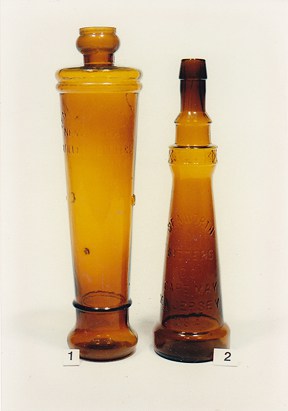
Carlyn Ring example of the General Scotts Artillery Bitters next to a Seaworth Bitters.

Pictured on the left is nicest known example of a General Scotts Artillery Bitters. This is the Carlyn Ring example that was sold in a Glass Works sale in 1995. The primary ‘keeper’,  and that is all we really are, of this bottle for the next decade or so was Don Keating. The bottle now resides in the collection of Sandor P. Fuss in Denver, Colorado.

Read further: Carlyn Ring Collection: First Offering of 143 Bottles – Part 1
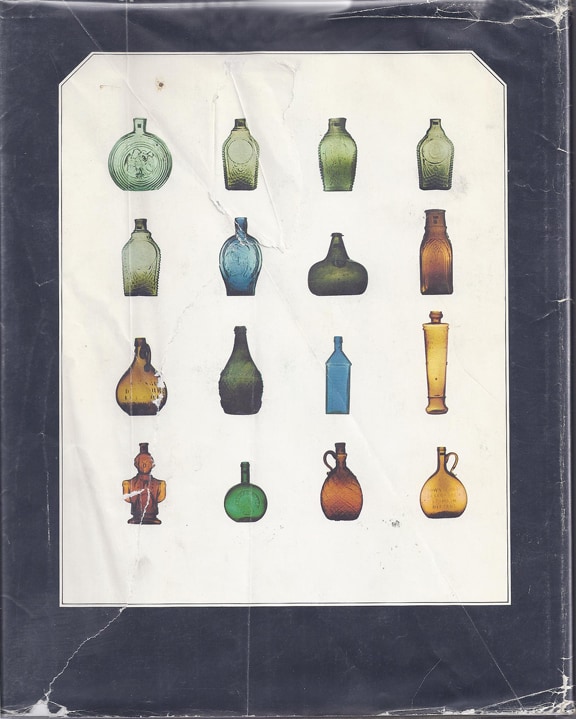
Skinner Auction Gallery Back Cover – 1975- Charles Gardner Collection (General Scotts in 12th position)


Kyle Example

The second example resides with Bitters collector Dave Kyle in Thousands Oaks, California. Dave states in a recent email “I do have an example I got from Ed Herrold, it has a bad epoxy repair on top but still certainly recognizable as an example, given its extreme rarity” (see picture of 4 Dave Kyle Cannon’s below).

Dave Kyle also adds a follow up note:Scott earned the nickname, “Old Fuss and Feathers” because of his attention to detail and fondness for flashy uniforms” also, “Scott was forced from command by President Abraham Lincoln at the dawn of the Civil War. His views on how to fight the confederacy were derided but ultimately prophetic”

“I dug my best bottle, a Gen. Scott’s Artillery Bitters (in the shape of a cannon).”

Read: Digging adventures in Savannah (Savannah Diggin’s) in the FOHBC March | April 2011 issue of Bottles and Extras.
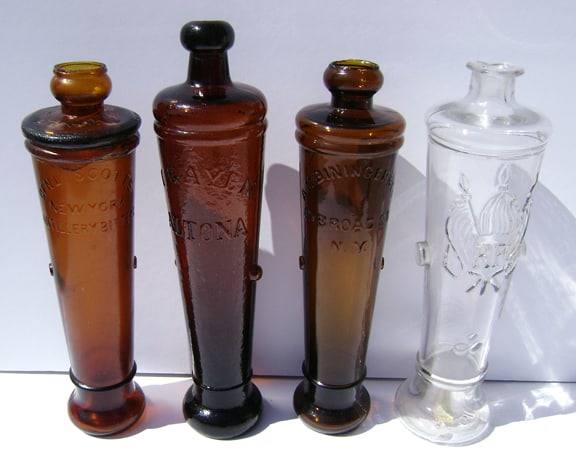
Left to Right: GENERAL SCOTTS ARTILLERY BITTERS, J.T. GAYEN / ALTONA, A.M. BININGERS and a R/F DEPOSE 13 Inch Repro, probably a French Cannon – Kyle Collection


Taylor Example

This bottle was badly stained and was purchased in a partnership by Bitters Collectors Jim Mitchell (Tampa, Florida) and Bill Taylor (Oregon). Bill eventually bought out Jim’s share in the bottle and took possession. I had the opportunity of seeing this bottle at Jim Mitchell’s sales table in Keene, New Hampshire at the Yankee Bottle Show that year and was impressed that it was found but concerned with its condition. Bill Taylor elected to have Bill Ham professionally clean the bottle and from what I understand, Bill (Ham) cleaned it and did a great job and the Bill (Taylor) that now owns it, is happy.


Aprill Example
Left: R. & G.A. WRIGHT. Middle: GENL SCOTT’S. ex. Carlin Ring Right: A. M. BINNINGER & Co., original label “Great Gun Gin” ex. Charles Gardner. – Charles Aprill

This next example, was recently confirmed and resides in the collection of Jane and Charles Aprill in New Orleans, Louisiana. This example is also ex: Carlyn Ring. According to Charles, when Carlyn Ring obtained her better example (now Fuss collection) she called him to dispose of her “old one”.  He said he was glad to pick up her “used bottle”.

From Charles Aprill: Before Carlin Ring got the General Scott’s cannon that is mentioned above, she owned another which suffered from moderate “ground etching”. It was completely intact. She had it cleaned; it was OK. It WAS an intact General Scott’s.

When she got a chance at the perfect example, she let jane and I have her less than perfect specimen. We were happy to get her “leftovers”. It has a happy home with a few other cannons.


Sidney Genius Example

For several months in 1968 Robert Hinely was digging a large dump on Duley Street in Savannah, Georgia. On Oct. 5, while digging in an area where an abandoned railroad track crossed over a marshy fill he unearthed a case of twelve Scotts Artillery Bitters bottles. All had various degrees of damage, many being in pieces.

44. “GENL SCOTTS / NEW YORK / ARTILLERY / BITTERS”, (Ring/Ham, S-78), American, ca. 1865 – 1870, yellowish amber figural cannon, 12 1/8”h, smooth base, sheared and ground lip. The entire base below the lower ring the neck and mouth are replacements from other Scott’s Artillery bottles. Also some minor inside stain. For several months in 1968 Robert Hinely was digging a large dump on Duley Street in Savannah, Georgia. On Oct. 5, while digging in an area where an abandoned railroad track crossed over a marshy fill he unearthed a case of twelve Scotts Artillery Bitters bottles. All had various degrees of damage, many being in pieces. This bottle was assembled from three of those bottles. Today, only four examples of the Scott’s Artillery Bitters are know to exist, two are reassembled examples and a third, also from that dig has a sizable ‘V’ shaped chip off the side of the lip. The fourth bottle, originally in the Charles Gardner Collection is the only known perfect example. In 1997 we auctioned the example with the large ‘V’ shaped chip out of the lip for $6,300.00! Sidney Genius Collection. – Glass Works Auctions ‘Early June’ Potpourri Auction #131


Read Further: Figural Cannon Bottles – J T GAYEN / ALTONA

Read Further: A. M. Bininger & Co. Figural Cannon
Posted in Bitters, Civil War, Collectors & Collections, Figural Bottles, History | Tagged , , , , , , , , , , , , , , , , , , , , | 2 Comments